What Is MiniMax? Open Models, Long Context, and Deployment Choices
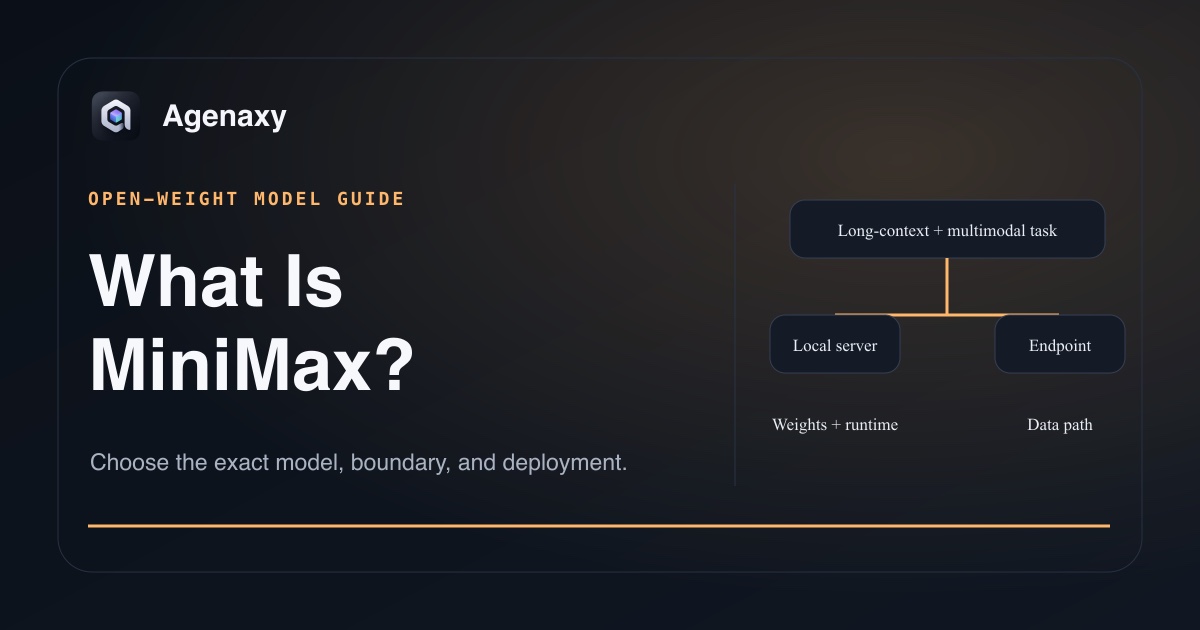
Quick answer: MiniMax is a Chinese AI company that offers hosted products and publishes selected open-weight models. Its recent models target agent, coding, long-context, and multimodal work, but the flagship artifacts are very large. Open weights give you deployment options; they do not guarantee laptop fit, a fully open training recipe, or unrestricted terms.
Evaluate the exact release, not “MiniMax” as a single product.
What MiniMax publishes
MiniMax's official Hugging Face organization contains multiple model generations and modalities. The MiniMax-M3 model card describes a 427B-parameter multimodal model and documents local serving through SGLang, vLLM, Transformers, and KTransformers. Its listed weight size is roughly 854GB before any alternative quantization or serving optimization.
That is an open-weight server-class release, not a normal MacBook download. Earlier or differently sized MiniMax releases can have different architectures, capabilities, and terms.
Is MiniMax open source?
Selected MiniMax model weights and inference materials are public, but the exact openness varies by release. MiniMax-M3 uses the MiniMax Community License rather than Apache 2.0 or the standard MIT License. The license requires attribution and notice for commercial use, requires prior written authorization above its stated annual-revenue threshold, and includes prohibited-use clauses.
This article is not legal advice. Read the current license for the exact artifact and obtain professional review when the obligations matter. Do not transfer M3's terms to M2 or a future model.
What long context changes
A large advertised context window can be useful for repositories, long documents, or multi-step agent state. It is also a maximum capability, not a free default. More tokens increase prompt-processing time and KV-cache memory, while irrelevant material can reduce answer quality.
For a 200-page policy set, compare these complete workflows:
- retrieve only relevant sections into a smaller local model;
- load a much larger context into a self-hosted MiniMax server;
- send the selected material to an approved hosted endpoint.
Use the same questions, source citations, and error checks. Measure not just whether the prompt fits, but whether the answer finds the right clauses, cites them correctly, and finishes within an acceptable time.
A release-fit card
Before choosing MiniMax, record:
| Field | Question |
|---|---|
| Artifact | Are the exact weights available, and in which precision or quantization? |
| Runtime | Does your vLLM, SGLang, Transformers, or KTransformers version support it? |
| Capacity | Can the whole serving system hold weights, cache, and concurrent requests? |
| Modality | Are the vision components and preprocessing path included? |
| License | What attribution, commercial, redistribution, or use conditions apply? |
| Data path | Which files, prompts, logs, tools, and telemetry leave controlled infrastructure? |
If one field is unknown, the deployment decision is not complete.
When MiniMax is a strong candidate
Test MiniMax when long-context, multimodal, coding, or agent behavior is material and the team can support the serving footprint. It can also be relevant when version pinning or controlled infrastructure matters.
Choose a smaller model or managed endpoint when infrastructure work would exceed the value of the task. A very large open-weight model can offer more control while costing more to operate than a closed API.
Where Agenaxy fits
Agenaxy keeps the durable work—files, rules, sessions, run evidence, and artifacts—in a local workspace. Standard can use a selected local or cloud model; a cloud model receives the context sent for that task. In Vault, every model Connection must be explicitly authorized by you. An authorized remote server still receives the context sent to it, while outbound-data tools remain unavailable and agent-run scripts are blocked from network access.
Continue with local AI vs cloud agents or the local LLM deployment guide.
Test a MiniMax workflow
Describe a representative, non-confidential task in the Download Agenaxy form. Compare complete systems rather than model labels.
FAQ
Can MiniMax-M3 run on a Mac?
The official full-precision artifact is far beyond a normal laptop's memory. A future or community quantization may change storage needs, but architecture support, memory, speed, and license still require separate verification.
Does a large context window remove the need for retrieval?
No. Retrieval can reduce cost, latency, and irrelevant context. Test both approaches on the same documents.
Are all MiniMax models under the same license?
No. License terms can vary by release. Read the exact model card and license file.
Sources and Fact-Checking Notes
- MiniMaxAI official Hugging Face organization indexes public model releases.
- MiniMax-M3 official model card documents architecture, artifact size, modalities, and runtimes.
- MiniMax-M3 license is the release-specific terms anchor.
- Product facts were verified on August 5, 2026.