Find the Best Ideas Hiding in Your Private Content Archive
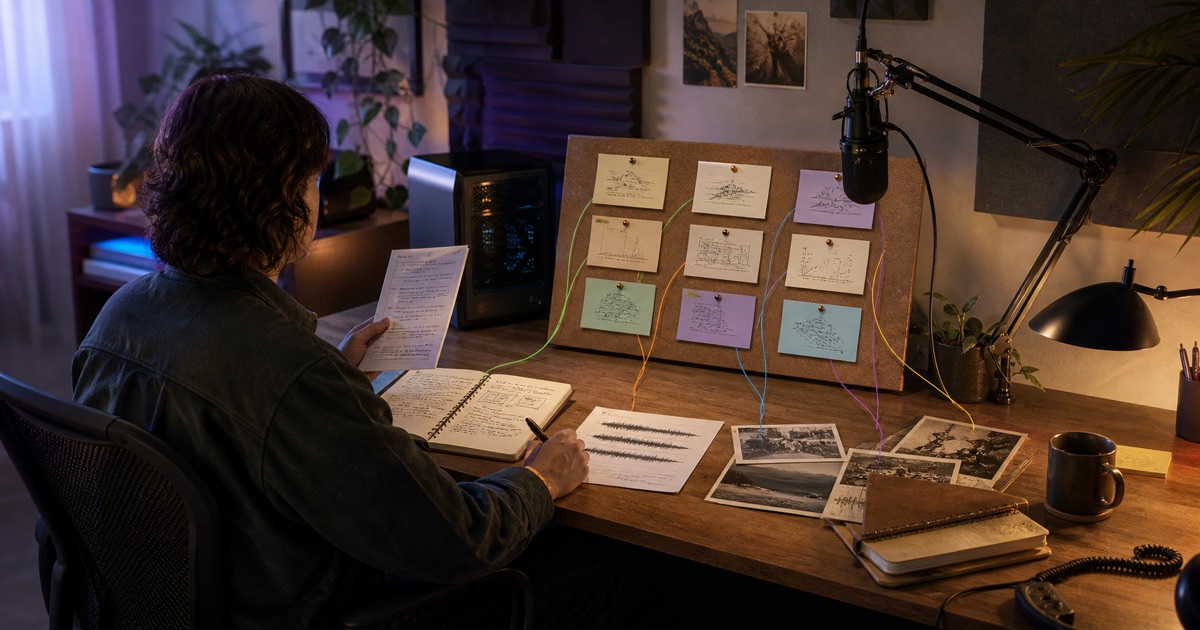
You remember the idea, but not where you left it. Maybe it was one sentence in an interview transcript, a note written after midnight, or the opening you cut from a draft two years ago. Sometimes you know what you are looking for. More often, you only know the archive contains something worth using—you just cannot see which fragments belong together.
This workflow builds on Agenaxy foundations that already matter for the job: a local or explicitly trusted model connection, imported inputs kept separate from new Artifacts, and Activity/Trace for reviewing the run. The useful result is a source-backed pitch memo you can open on your next writing day—with the kept angle, supporting fragments, parked alternatives, and facts still to verify. Your sources, facts, rights, voice, and final publication decision still stay with you.
The useful result is a trail you can follow
For a creator, “organize my archive” is too vague. A better result has three properties:
- Originals stay separate. Notes, transcripts, and drafts remain source material; new cards and drafts are written as separate artifacts.
- Every idea has a way back. A filename plus a heading, page, timestamp, or paragraph lets you recover the surrounding thought.
- The model proposes; you choose. It can connect fragments and offer angles, but it does not decide which idea is true, yours to use, or ready to publish.
The four invented fragments below come from one writer’s selected files, but they were not written to make the same point. The useful connection has to be discovered rather than copied from the input.
| Source | Type | Fragment as written |
|---|---|---|
interviews/2023-11-golden-lily.txt |
Voice-memo transcript · 31:04 | “My daughter rebuilt the menu on a tablet. She runs the till, the orders, the suppliers. She cannot make the broth yet—and her mother could never do the orders.” |
notes/2024-06-field-notes.md |
Field note · paragraph 7 | “Queue outside is tourists with phones. The regulars come at two, after the rush, when the daughter is alone in front.” |
drafts/2024-09-closures-essay.docx |
Discarded opening | “Every family restaurant is one bad year away from becoming a real-estate listing.” |
mail/2025-02-reader-replies.md |
Reader reply · paragraph 3 | “I don’t miss the food. I miss knowing the person who made it.” |
From that bounded input, one possible output is a pitch memo the writer can actually open on the next writing day:
What the Daughter Inherits
Succession stories obsess over the recipe. In these shops the recipe transfers fine; what is fragile is the room—the regulars, the rhythm, the person out front. A family restaurant hands down two businesses, and usually only one survives.
interviews/2023-11-golden-lily.txt · 31:04The skills split two ways, not one.notes/2024-06-field-notes.md · ¶7Two clienteles share one room at different hours.mail/2025-02-reader-replies.md · ¶3A reader names what customers feel they lose.
drafts/2024-09-closures-essay.docx is a different piece. It needs rent data that is not in this run.
Reopen notes/2024-06-field-notes.md · ¶7 and compare it with the June photos.
The memo is useful because it records selection, not just generation. The writer can challenge the proposed angle, reopen every quotation, see why one candidate was parked, and start the next session with the unresolved fact still visible.
Three moves, not a content factory
1. Inventory what is actually there
Start one Agenaxy run with a project or season—not an entire drive. Before adding files, choose the model boundary for the run: a local model that keeps task context on the machine, or an explicitly trusted model connection. Supply only that file set and keep new work in the run's Artifacts area. The first pass should record filenames, file types, dates when available, extraction failures, and possible duplicates.
This is deliberately unglamorous. If three interview transcripts were unreadable, you want to know before a polished theme list creates false confidence. The inventory also gives you a clean moment to remove collaborator material, licensed references, personal records, or anything else that does not belong in the run.
2. Connect fragments without erasing their differences
Give the selected model a few editorial questions or themes you already use. Ask it to group related fragments, but require a source location on every card and a proposed label on any category it invents.
A useful connection might join a voice memo or its transcript, a rejected opening, and an interview observation around the same audience question. The model should not silently turn a third-party quotation into your opinion or merge three tentative thoughts into one confident claim. Provenance keeps those distinctions visible.
3. Draft from selected cards
Review the cards first. Mark the ones with verified facts, usable rights, and enough context. Then ask for two or three different angles from that selected set—for example, a story opening, a practical question, and a counterintuitive claim.
Keep generated language in a separate Agenaxy Artifact with the card IDs or source references it used. Review it alongside the run's Activity/Trace—the relevant steps, tool calls, and file operations—before deciding what becomes a draft. The goal is a better starting point with a fast route back to the source.
Keep your sources and your voice
The U.S. Copyright Office's general FAQ explains that copyright can cover published and unpublished original works once they are fixed in a tangible form. Its copyright overview is a useful starting point, but neither page decides the rights in a particular archive or AI-assisted draft.
Keep the human checks together:
- Open the cited source before relying on a fact, quotation, or remembered story.
- Confirm collaborator permissions, licenses, attribution, and any third-party restrictions.
- Read for your own voice; reject generic transitions and conclusions you would not make.
- Decide what is ready to publish and keep unfinished cards clearly marked as drafts.
Local execution changes the data path, not those responsibilities. A model running on the same machine can keep model context there. Standard mode can use a local or selected cloud model; Vault Mode limits a run to explicitly authorized model connections and local tools that do not send data out. Remote tools, approved servers, or deliberate exports can still receive what you send them. See what leaves your machine and the full Vault Mode boundary before choosing a setup for unpublished work.
FAQ
Can local AI find ideas across notes, drafts, and transcripts?
It can inventory readable files, connect related fragments, and produce source-linked idea cards. Start with a bounded collection, review extraction failures, and treat every proposed theme as something the creator can change or reject.
Does a local model keep my archive out of a cloud model?
A model running on the same machine does not need to send its task context to a remote model. Connected tools, approved servers, and deliberate exports are separate data paths, so choose those boundaries before opening unpublished material.
Does this settle copyright, attribution, or authorship?
No. Local processing does not decide ownership, permission, fair use, attribution, authorship, or whether an AI-assisted draft is protectable. Verify the sources and rights that apply to the specific work, and keep the final editorial decision human.