What Is GLM? Open-Weight Models from Z.ai Explained
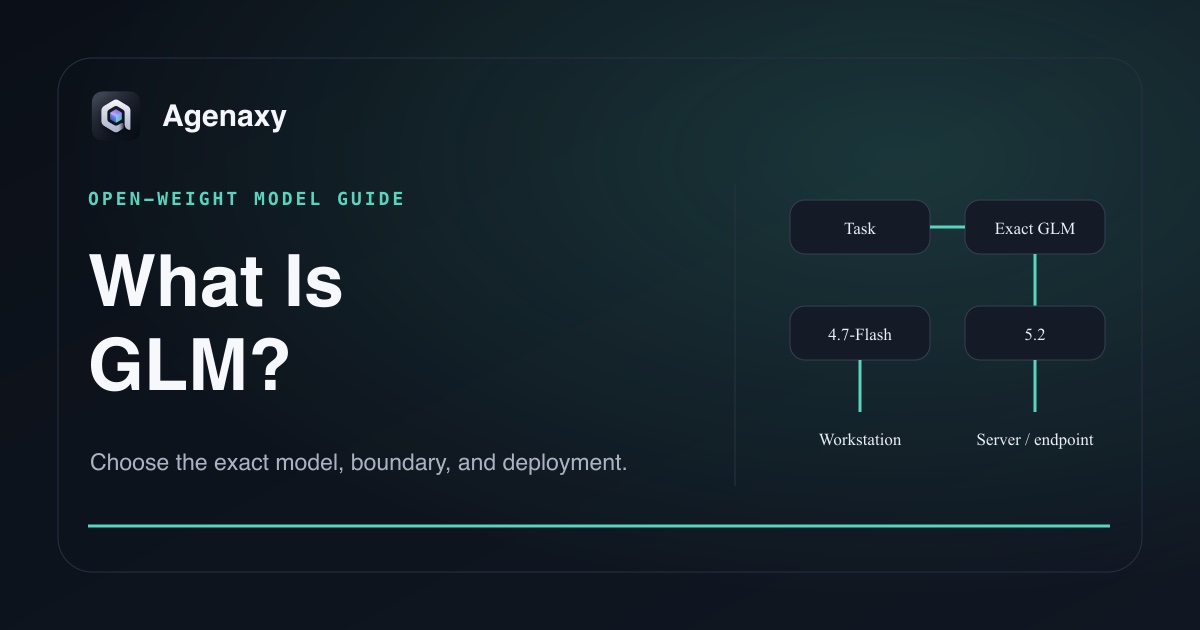
Quick answer: GLM is a changing family of language and agent models developed by Z.ai. Some GLM releases publish weights and serving code, but GLM is not a single laptop model. Current flagship-class releases can be hundreds of billions of parameters and are primarily server deployments; older or smaller releases may be more practical locally.
Choose an exact version only after checking its model card, license, runtime support, memory footprint, and hosted alternative.
What GLM refers to
The GLM name spans generations and purposes rather than one permanent specification. Official Z.ai repositories include model weights, inference instructions, and serving integrations for selected releases. As of August 5, 2026, the GLM-5 repository identifies GLM-5.2 as the current flagship and also lists GLM-5.1 and GLM-5. These releases use a 744B-A40B mixture-of-experts architecture; GLM-5.2 documents a maximum context of one million tokens.
That mixture-of-experts design reduces active computation relative to a dense 744B model, but it does not make the weight files laptop-sized. You still need memory and storage for the distributed artifact and a compatible serving stack.
Is GLM open source?
GLM releases are often described as open models, but open-weight is the safer family-level description. The GLM-5 repository uses the Apache 2.0 license. Historical releases, hosted services, and future models can have different artifacts or terms.
Inspect the exact release instead of inheriting a license from the brand name. Also separate access to weights from access to training data, training code, hosted infrastructure, and service policies.
Can GLM run locally?
“Local” can mean a laptop, a workstation, or a server cluster you control. The official GLM-5 deployment instructions cover runtimes such as vLLM, SGLang, xLLM, and KTransformers—tools aimed at serious serving environments.
For a smaller current candidate, GLM-4.7-Flash is a 30B-A3B model released under MIT with documented Transformers, vLLM, and SGLang paths. It is lightweight relative to GLM-5.2, but its full-precision artifact is still a workstation or server decision; verify an exact quantized artifact before treating it as laptop-sized.
Before downloading, answer four questions:
- What is the artifact size? A sparse model still stores all experts unless the release provides a smaller variant.
- Which runtime supports the exact architecture and quantization? A generic model loader is not enough.
- How much context do you actually need? Larger KV caches consume more memory.
- Is a local server operationally justified? Hosted access may be simpler when provider terms fit the workload.
Same task, three deployment choices
Imagine an engineering team asking a model to inspect a repository, propose a patch plan, and produce a source-linked risk checklist. Hold the repository snapshot, prompt, tools, and acceptance tests constant.
| Path | What it tests | Main tradeoff |
|---|---|---|
| GLM-4.7-Flash on a capable workstation or small server | lighter local fit and interactive use | still requires exact artifact and runtime validation |
| GLM-5.2 on controlled servers | current flagship under deployment control | substantial memory, serving, and maintenance work |
| GLM through an approved endpoint | fast access to a managed system | external data path and provider dependency |
Score patch relevance, cited files, unsupported claims, latency, total operating cost, and where repository content travels. The family name does not decide the result.
When GLM is a strong candidate
GLM is worth testing when you need its language, coding, tool-use, or agent-oriented behavior and you can support the exact release. Open weights can help with version pinning, controlled deployment, and runtime choice.
It is a weak fit when the only reason is “open source,” when the model cannot fit the available system, or when your team does not want to operate inference. A smaller model from another family may produce a better complete system.
Where Agenaxy fits
Agenaxy treats the model connection as replaceable. Files, rules, sessions, run evidence, and artifacts stay in the local workspace while a task uses a local GLM server or another selected model. Standard can use a selected local or cloud model; a cloud model receives the context sent for that task. In Vault, every model Connection must be explicitly authorized by you. An authorized remote server still receives the context sent to it, while outbound-data tools remain unavailable and agent-run scripts are blocked from network access.
For the next decision, see open-source vs closed-source AI and how to run an LLM locally.
Test a GLM workflow
Describe a representative, non-confidential workload in the Download Agenaxy form. Keep the task and acceptance checks constant across models.
FAQ
Is GLM the same as ChatGLM?
ChatGLM is associated with earlier conversational releases. GLM now names a broader, evolving model family. Use the exact repository and version in technical decisions.
Does mixture-of-experts mean GLM fits in less memory?
It can reduce active computation, but the system generally still needs access to all model weights. Activated parameters and stored parameters answer different capacity questions.
Is a self-hosted GLM automatically private?
No. Check logging, telemetry, embeddings, tools, package downloads, and network paths around the inference server.
Sources and Fact-Checking Notes
- Z.ai official GitHub organization is the release index used here.
- GLM-5 official repository documents current model sizes, license, and supported serving runtimes.
- Product facts were verified on August 5, 2026. Recheck the exact release before deployment.