What Is Kimi? Open-Weight Models from Moonshot AI Explained
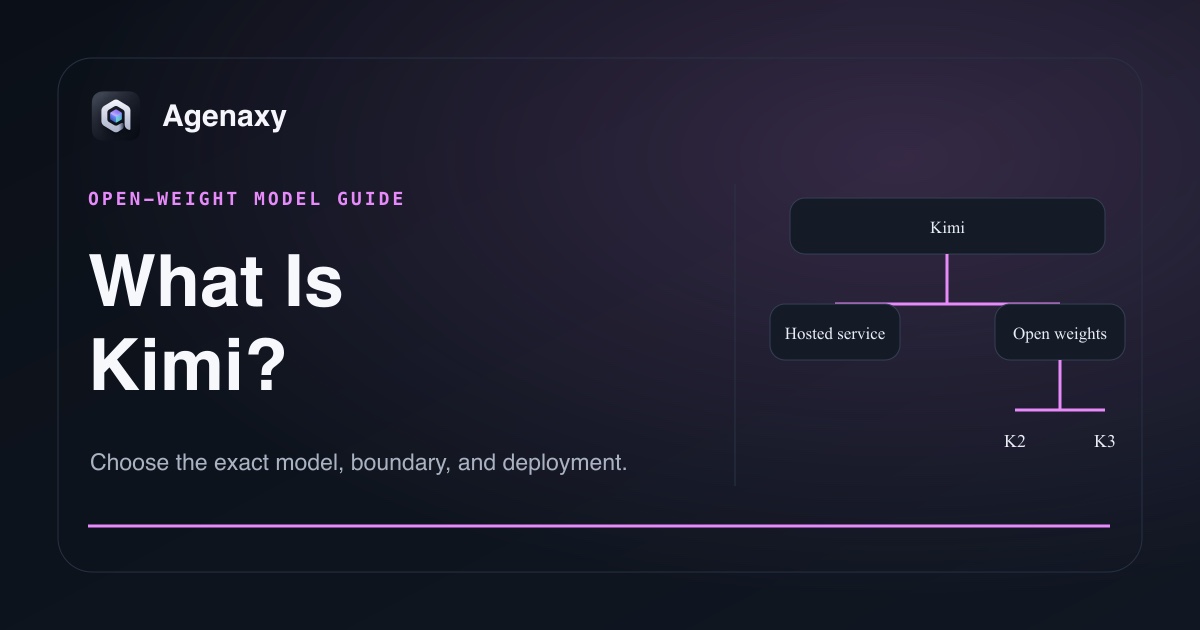
Quick answer: Kimi is a model and product family from China's Moonshot AI. The name covers a hosted assistant and open-weight releases such as Kimi K2 and Kimi K3. Kimi K3 is a very large native multimodal, agent-oriented model with a maximum context of up to one million tokens; it is a server-class deployment, not a typical laptop model.
“Kimi is open source” is too broad. Check the exact release, because weights, code, capabilities, and licenses differ.
Kimi service vs Kimi model weights
Using Kimi's hosted product means prompts follow Moonshot's service path. Downloading Kimi weights and serving them on hardware you control creates a different data path and operating responsibility.
The official Kimi K3 repository describes 2.8 trillion total parameters with 104 billion activated parameters and recommends serving runtimes including vLLM, SGLang, and TokenSpeed. That scale normally implies multi-accelerator infrastructure even though only a subset of experts activates for each token.
Kimi K2 is an earlier open-weight model line with its own architecture, deployment instructions, and Modified MIT license. K3 uses a separate Kimi K3 license. Family names do not replace release files.
Is Kimi open source?
Kimi publishes weights and code for selected releases, so open-weight is the reliable umbrella term. K2 and K3 demonstrate why release specificity matters: both provide artifacts, but their licenses are not the same. K3's custom license grants broad permissions with conditions that can apply to some model-as-a-service or very large commercial uses.
Read the current license; this is not legal advice. Also ask whether training data, full training code, evaluation data, and hosted service behavior are available—the answer may differ from weight availability.
Long context is a capacity, not a default
A maximum one-million-token window does not mean every task should use it. The KV cache, prompt-processing time, attention implementation, and irrelevant material all affect the complete system.
Consider a repository review task with source code, design documents, and issue history. Test three strategies:
- a retrieved subset with a smaller local model;
- a larger curated bundle with self-hosted Kimi;
- the same curated bundle through an approved Kimi endpoint.
Score cited-file accuracy, missed dependencies, unsupported claims, time to first output, total cost, memory, and the data path. A larger context wins only if it produces a better acceptable result.
When Kimi fits
Kimi is worth evaluating when long-context, multimodal, coding, or agentic behavior is central and you have a compatible serving path. Open weights can support controlled infrastructure, version pinning, and runtime choice.
It is a weak local fit when the available machine cannot hold the model, when latency is interactive, or when the operating burden is larger than the workload. A smaller Qwen, DeepSeek distill, or another compact model may be the better local system even if a Kimi flagship is stronger on some evaluations.
What to verify before deployment
- exact Kimi release and weight precision;
- license and base-model obligations;
- supported runtime version and chat template;
- storage, memory, cache, and concurrency budget;
- tool-calling and multimodal components required by the task;
- logging, telemetry, remote tools, and endpoint data policy.
Where Agenaxy fits
Agenaxy keeps files, rules, sessions, run evidence, and artifacts in a local workspace. Standard can use a selected local or cloud model; a cloud model receives the context sent for that task. In Vault, every model Connection must be explicitly authorized by you. An authorized remote server still receives the context sent to it, while outbound-data tools remain unavailable and agent-run scripts are blocked from network access.
See what open-source AI actually opens and what AI model your Mac can run for the adjacent decisions.
Test a Kimi workflow
Describe a representative, non-confidential workload in the Download Agenaxy form. Keep the task and acceptance checks unchanged across models.
FAQ
Can Kimi K3 run on a Mac?
Not as a normal single-Mac deployment at the official full scale. Smaller derivatives or future quantizations need their own architecture, memory, quality, and license review.
Is the one-million-token context always better?
No. It is a maximum capacity. Retrieval and a smaller curated context may be faster and more accurate for a specific task.
Are Kimi K2 and K3 licensed the same way?
No. K2 uses a Modified MIT license, while K3 has a separate custom license. Read the exact current files.
Sources and Fact-Checking Notes
- MoonshotAI official GitHub organization indexes public releases.
- Kimi K3 official repository documents model scale, context, deployment, and license.
- Kimi K2 official repository documents K2's separate release and terms.
- Product facts were verified on August 5, 2026.