What Is Qwen? Alibaba's Open-Weight Model Family Explained
Quick answer: Qwen is Alibaba's broad family of language, coding, vision, audio, and agent-oriented models. Many Qwen releases publish downloadable weights in several sizes, making the family useful for both local experiments and server deployments. There is no single “Qwen model”: choose the exact generation, variant, parameter size, quantization, and runtime for the task.
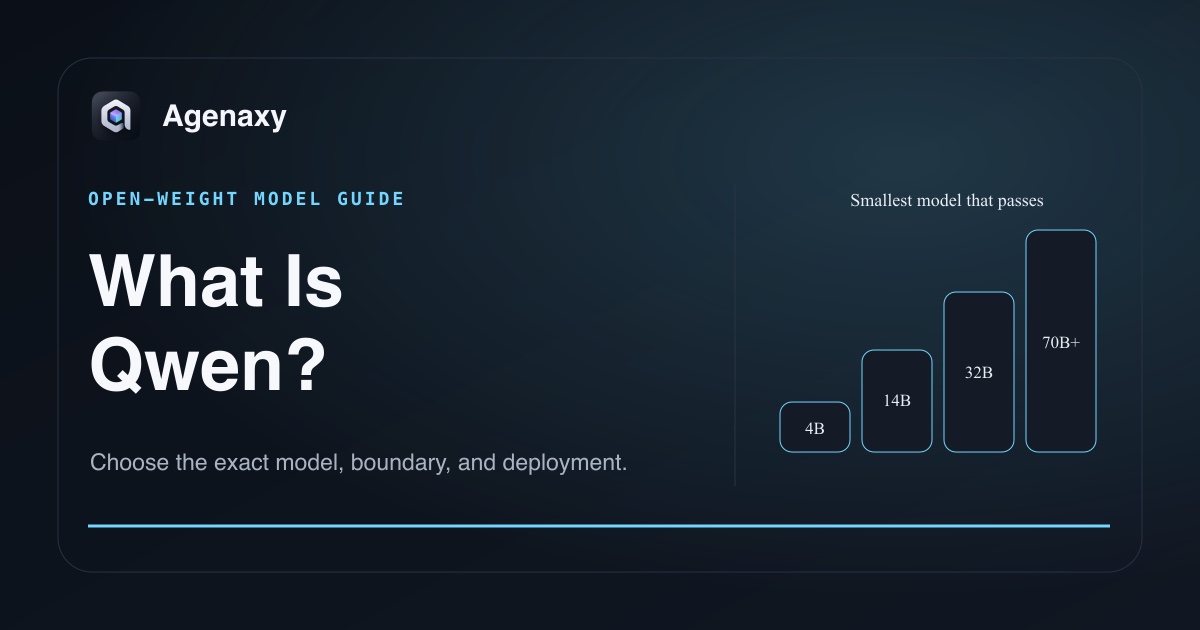
For local work, start with the smallest Qwen release that might pass your evaluation. A larger model is useful only if the quality gain justifies the memory and latency.
Why there are so many Qwen names
Qwen releases vary along several axes:
- generation: for example Qwen3 and Qwen3.6;
- size: dense and mixture-of-experts models at different parameter counts;
- modality: text, vision-language, audio, and other specialized lines;
- purpose: general instruction following, coding, reasoning, embedding, or tool use;
- format: full-precision weights, quantized artifacts, GGUF conversions, or MLX-compatible packages.
These variants are a strength when you need a hardware-sized model, but the family label alone cannot tell you what will load.
Is Qwen open source?
Many current Qwen models are distributed as open weights. The official Qwen3.6 materials state that its open-weight models use Apache 2.0 and document weights on Hugging Face and ModelScope. Older releases or specialized services can differ.
Use open-weight when discussing the family, then inspect the exact repository, model card, license, tokenizer, code, and base artifacts. Downloadable weights do not necessarily include training data or a reproducible training pipeline.
Which Qwen size should you use?
Use a smallest-model-first loop:
- define a representative task and acceptance checks;
- choose a supported 4-bit or similarly compact artifact;
- leave memory headroom for the operating system and context cache;
- test output quality, latency, and failure cases;
- move up one size only when a measured failure justifies it.
| Model-size band | Good first tests | Main constraint |
|---|---|---|
| 0.5B–4B | classification, short extraction, simple rewriting | limited reasoning and instruction reliability |
| 7B–14B | drafting, multilingual work, light coding, structured extraction | quality varies sharply by task |
| 27B–35B | stronger coding, synthesis, and tool-oriented work | usually needs 32GB-class or greater systems |
| 70B+ or flagship MoE | demanding server workflows | memory, storage, concurrency, and operations |
The table is a planning guide. Exact artifact sizes and architectures matter more than the rounded parameter label.
Same task across two Qwen sizes
Suppose a multilingual operations team needs to turn Chinese and English support exports into a source-linked issue brief. Hold the files, taxonomy, output schema, and verification set constant.
Test a smaller Qwen model first. Count correct issue assignments, missing citations, invented details, and language-switching errors. Then run the next larger candidate only on the same set. Record memory, context, latency, and whether any embedding, tool, or logging path is remote.
If the smaller model passes, its speed and deployability may matter more than an abstract benchmark advantage. If it fails a specific acceptance check, the larger model has a concrete reason to exist.
Local runtimes
Official Qwen3.6 deployment materials cover Transformers-based serving, llama.cpp, MLX on Apple silicon, SGLang, and vLLM. Runtime support can lag a new architecture, so verify the exact release and version instead of assuming every Qwen artifact works everywhere.
For a first local setup, a desktop runtime can reduce configuration. For controlled production serving, an API-compatible server, monitoring, access controls, and version pinning become part of the system.
Where Agenaxy fits
Agenaxy keeps files, rules, sessions, run evidence, and artifacts in a local workspace while models remain replaceable. Standard can use a selected local or cloud model; a cloud model receives the context sent for that task. In Vault, every model Connection must be explicitly authorized by you. An authorized remote server still receives the context sent to it, while outbound-data tools remain unavailable and agent-run scripts are blocked from network access.
Next, read how to run an LLM locally and open-source vs closed-source AI.
Test a Qwen workflow
Describe a representative, non-confidential workflow in the Download Agenaxy form. Start with the smallest candidate that might pass.
FAQ
Is Qwen good for Chinese and English?
Qwen is positioned as multilingual, but task quality depends on the exact release, size, prompt, and data. Test both languages with representative examples.
Can Qwen run on Apple silicon?
Yes, selected releases have llama.cpp or MLX-compatible paths. Whether a model fits depends mainly on artifact size, unified memory, context, and runtime support.
Are all Qwen models Apache 2.0?
Do not assume so. Current Qwen3.6 open-weight materials use Apache 2.0, but verify the exact historical or specialized release.
Sources and Fact-Checking Notes
- QwenLM official GitHub organization indexes model-family releases.
- Qwen3.6 official README documents current sizes, license, and serving paths.
- Qwen3 official repository documents earlier local and server deployment options.
- Product facts were verified on August 5, 2026.