What Is DeepSeek? Open Models, Local Deployment, and Tradeoffs
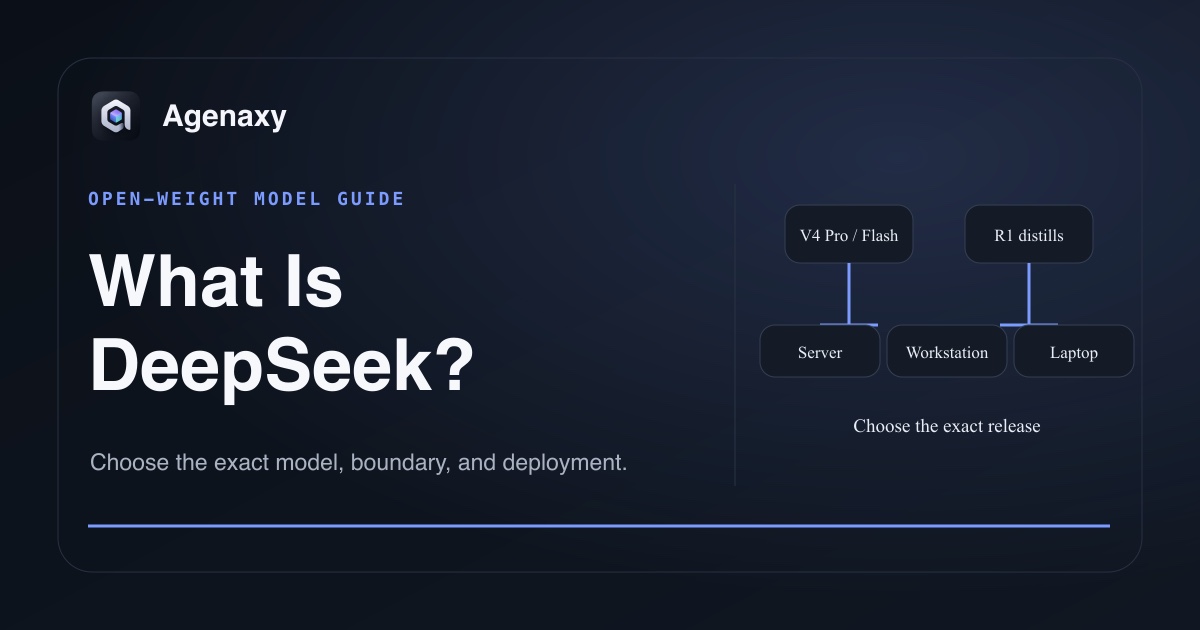
Quick answer: DeepSeek is a family of AI models from a Chinese research company, not one model or one app. Its current open-weight V4 line includes the large V4-Pro and the smaller—but still server-scale—V4-Flash. Earlier releases include the reasoning-focused DeepSeek-R1 and smaller R1 distilled models. The exact license, hardware requirement, and data path depend on the release and how you run it.
For a local first test, a distilled 8B, 14B, or 32B R1 variant is usually more realistic than a full server-class release. “DeepSeek” alone is not enough information to choose.
What the DeepSeek name covers
DeepSeek publishes multiple model lines. Two useful anchors are:
- DeepSeek-V4: the current general-purpose line. The official release describes V4-Pro as 1.6 trillion total / 49 billion active parameters and V4-Flash as 284 billion total / 13 billion active parameters, with open weights and a one-million-token context window.
- DeepSeek-R1: an earlier reasoning-focused family with the full R1 model and distilled models based on smaller Qwen or Llama foundations.
V4-Pro, V4-Flash, and full R1 target server-class deployments. Distilled R1 variants trade some capability for much smaller weights and easier local inference. A hosted DeepSeek endpoint is another deployment choice; it is not the same data path as loading weights on your own machine. For the official API, the current model names are deepseek-v4-pro and deepseek-v4-flash; the older deepseek-chat and deepseek-reasoner names were retired on July 24, 2026.
Is DeepSeek open source?
Use the more precise term open-weight unless you have inspected the complete release. The official DeepSeek-V4-Pro model card lists an MIT license. The DeepSeek-R1 repository also publishes code and weights under MIT, while noting that distilled models inherit details from their Qwen or Llama bases.
That means the safe question is: “What does this exact repository provide, under which current terms?” Check the model card, license file, base model, runtime code, and any use restrictions before commercial or redistributed use.
Which DeepSeek model can run locally?
The Ollama DeepSeek-R1 page lists representative 4-bit-class artifacts from 1.1GB for 1.5B through 43GB for 70B. The memory bands below are planning inferences, not vendor requirements: they add working headroom to those artifact sizes for the runtime, operating system, and context cache. Use the full Mac unified-memory method before choosing hardware.
| Candidate | Practical role | Local fit |
|---|---|---|
| R1 distilled 1.5B–8B | learning, short extraction, light reasoning | realistic on many modern laptops when quantized |
| R1 distilled 14B | stronger drafting and reasoning | better with roughly 16–24GB or more available memory |
| R1 distilled 32B | more demanding local work | commonly a 32–64GB-class machine decision |
| R1 distilled 70B | high-memory local workstation or server | usually needs a large-memory Mac or accelerator server |
| V4-Flash, V4-Pro, or full R1 | heavyweight serving | not a normal laptop deployment |
These are planning bands, not speed guarantees. Quantization, context length, runtime, other applications, and model architecture change the working set. Start with the smallest candidate that could pass the task.
A same-task test
Suppose you want to turn a folder of technical incident reports into a table of symptoms, suspected causes, evidence, and unresolved questions. Use the same ten reports and acceptance checks for each candidate:
- require a citation to the source section for every extracted fact;
- count missing fields and invented claims;
- measure time to first useful draft and total run time;
- record peak memory and the context actually used;
- record whether prompts, files, logs, or tools contact a remote service.
An 8B distill may be fast but miss cross-document relationships. A 32B distill may improve the draft but reduce interactivity. The full hosted model may perform differently while creating a different data path. The useful winner is the smallest complete system that meets the acceptance criteria.
What DeepSeek does not decide for you
Open weights do not make an application offline. A local model can still sit behind a client that uses remote embeddings, web search, telemetry, or networked tools. Conversely, a hosted model is not automatically unsuitable; its provider terms and the workload's data requirements may be acceptable.
Model output also needs verification. Reasoning traces are not proof, and a longer answer is not necessarily a more reliable one.
Where Agenaxy fits
Agenaxy keeps files, rules, sessions, run evidence, and artifacts in a local workspace while letting you choose a model per task. Standard can use a selected local or cloud model; a cloud model receives the context sent for that task. In Vault, every model Connection must be explicitly authorized by you. An authorized remote server still receives the context sent to it, while outbound-data tools remain unavailable and agent-run scripts are blocked from network access.
Next, see how to run a large language model locally and what AI model your Mac can run.
Test a DeepSeek workflow
Describe a representative, non-confidential workflow in the Download Agenaxy form. Compare model candidates against the same files and acceptance checks.
FAQ
Is the DeepSeek app the same as running DeepSeek locally?
No. A consumer app or hosted API runs through someone else's service. Local inference means the model weights are loaded by a runtime on hardware you control.
Do I need the full DeepSeek-R1 model?
Usually not for a first evaluation. Distilled releases are designed to make some R1-style reasoning available in smaller models. Test them before committing to heavyweight infrastructure.
Is DeepSeek private by default?
No. Privacy depends on the complete data path: model location, application, logging, embeddings, tools, and network access.
Sources and Fact-Checking Notes
- DeepSeek V4 official release documents V4-Pro, V4-Flash, current API names, context length, and the retirement of the legacy API aliases.
- DeepSeek-V4-Pro official model card documents weights, architecture, deployment notes, and license.
- DeepSeek-R1 official repository documents the earlier R1 family, distills, base models, and release terms.
- Product facts were verified on August 5, 2026. Check the exact model card and license again before deployment.