Can Cloud AI Leak Your Data? Where the Risk Actually Lives
Quick answer: Yes. Data sent to a cloud AI service can be exposed if an account, application, model provider, integration, subprocessor, log, backup, or internal control fails. That does not make cloud AI inherently unsafe. It means the real security boundary is the complete processing chain—not a single vendor name, encryption badge, or “we do not train on your data” promise.
The practical response is not “never use the cloud.” Send the minimum data needed, choose a service whose controls match the workload, and keep data local when remote processing adds no necessary value.
Practical rule: Do not ask only “Do I trust this AI company?” Ask “Who can receive, store, derive, access, copy, or recover this data from upload through deletion?”
At a glance
- A cloud AI request may cross several independently operated systems even when the user sees one product.
- Provider failures, customer configuration, compromised identities, third-party incidents, and AI-specific retrieval flaws require different controls.
- “No training,” encryption, data residency, and certifications can be useful evidence, but none answers the whole data-lifecycle question by itself.
Cloud AI is a chain, not one destination
NIST's Generative AI Profile notes that generative-AI value chains can involve third-party datasets, pretrained models, software libraries, and integrations. NIST's Privacy Framework similarly treats privacy as a data-processing ecosystem spanning the organizations and components that handle data.
A simple AI chat may use fewer links than the diagram below. An enterprise agent connected to files, search, support, observability, and model APIs may use more. The point is to discover the real path instead of assuming that every participant, copy, and control belongs to the brand on the screen.
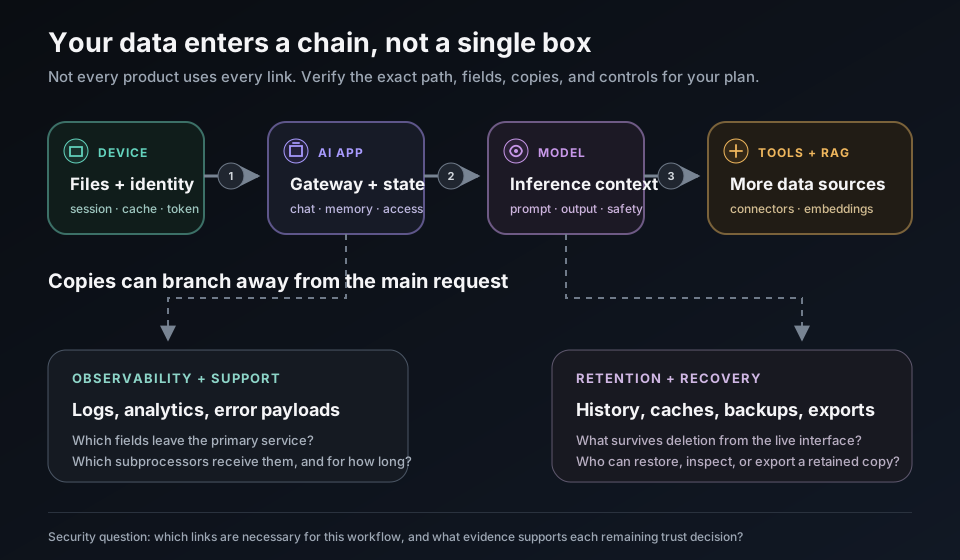
| Link in the chain | What may exist there | A representative failure | What to verify |
|---|---|---|---|
| Device, browser, or desktop client | Prompts, files, cached content, session tokens | Malware, an unsafe extension, or a stolen session exposes data before the provider handles it | Managed devices, extension policy, session controls, MFA, and local cache behavior |
| AI application and gateway | Uploaded files, conversation state, memory, permissions | A software bug or tenant-isolation error returns one user's data to another | Tenant separation, access design, security testing, and incident history |
| Model or inference provider | The context needed for a request and the generated output | Retention or access exceeds what the buyer expected | Exact data sent, training use, retention, human access, region, and deletion terms |
| Connectors, RAG, and tools | Retrieved documents, embeddings, tool arguments, external results | Overbroad permissions or weak retrieval isolation brings in another team's data | Source permissions, least privilege, per-tenant isolation, and tool egress |
| Logs, analytics, support, and security services | Metadata and sometimes content or error payloads | An analytics or support subprocessor is compromised | Subprocessor list, field-level logging, redaction, support access, and retention |
| Backups, caches, and recovery systems | Historical or duplicated data after the live item changes | A deleted chat remains in recoverable copies longer than expected | Deletion semantics, backup retention, restoration behavior, and legal exceptions |
| Administrative and incident operations | Privileged access, audit records, exports, investigation copies | Excessive privilege or a weak incident workflow expands exposure | Time-bound access, approval, auditability, notification, and evidence handling |
How data can leak without anyone making it public
Public sharing is only one exposure path. A conversation can remain unshared and still be affected by a failure elsewhere in the chain.
1. Identity or configuration fails
An attacker may steal a session, an employee may grant a connector too much access, or an administrator may apply the wrong audience or retention setting. Cloud providers usually operate part of the stack while the customer still owns decisions about data classification, identities, endpoints, permissions, and configuration. That is the core of the cloud shared-responsibility model.
2. Application or infrastructure isolation fails
Multi-tenant services must return the right data to the right user on every request. A bug in caching, authorization, routing, or storage can violate that separation even when the user made no mistake.
OpenAI's March 2023 postmortem is a narrowly documented example. OpenAI reported that a bug in the asynchronous Redis client could leave a response on a recycled connection, allowing the next unrelated request to receive another active user's data. Some users saw chat-history titles; OpenAI also said the first message of a newly created conversation might have appeared in another active user's history when both users were active around the same time. The bug may also have exposed limited payment-related fields belonging to 1.2% of Plus subscribers active during a specified nine-hour window; OpenAI said full card numbers were not exposed. The incident was not caused by a public share link.
3. A third-party provider fails
The company selling the AI product may use other companies for hosting, analytics, support, security, payments, or communications. A failure at one of those companies can expose the fields it receives without compromising the AI vendor's own infrastructure.
OpenAI's November 2025 Mixpanel notice illustrates that distinction. OpenAI said an attacker exported limited customer-identifiable and analytics information from its analytics provider. OpenAI also explicitly said the incident did not expose chats, prompts, API requests, passwords, credentials, API keys, payment details, or government IDs. The lesson is that the third-party provider map—including which vendors are processors or subprocessors—and the exact fields each one receives are part of the security answer.
4. AI retrieves or reveals data it should not
OWASP treats sensitive-information disclosure, prompt injection, and vector/embedding weaknesses as separate risks in LLM applications. A model can be induced to reveal information that an application made available to it, while weak RAG isolation can retrieve material from the wrong user or tenant. Prompt instructions such as “never reveal confidential information” are not a replacement for authorization and data separation outside the model.
5. The system keeps more data than the user expected
Prompts and files are not the only copies worth examining. Error traces, activity logs, embeddings, support tickets, abuse-monitoring records, caches, and backups may contain original or derived information. The UK National Cyber Security Centre specifically tells cloud buyers to consider credentials, configuration, metadata, logs, derived models, provider access, retention, and deletion—not only the primary database.
What common security statements may establish
Treat the first column as a statement to verify, not proof by itself. The current contract or policy, technical documentation, enabled configuration, applicable assessment report, endpoint and region scope, exceptions, and responsible party determine what the statement means for one workflow.
| Statement or label | What it may establish after scope is verified | Evidence and remaining question |
|---|---|---|
| “Encrypted in transit and at rest” | Specified data is cryptographically protected in specified transit and storage states | Which data, metadata, logs, backups, keys, algorithms, and processing states are in scope? |
| “We do not train on your data” | A current policy or contract limits one possible use of data within its defined scope | Which product, plan, fields, exceptions, serving logs, safety records, support copies, and backups does the language cover? |
| “Zero retention” | A documented request path may avoid provider-side storage after processing | Verify the endpoints, fields, abuse controls, integrations, exceptions, and configuration that qualify |
| “Enterprise security” | Nothing by itself; it is a plan or marketing label until specific controls and terms are identified | Which identity, admin, access, retention, contract, and support controls are included, enabled, and applicable? |
| “SOC 2” or another assessment | An independent report may evaluate a defined system and control scope at a stated date or over a stated period | Which report type, system boundary, date or period, exceptions, and subservice organizations are covered? |
| “Data residency” | The provider commits specified data or processing to stated locations within a defined scope | Which data, processing, support, backups, third parties, transfers, and exceptions are covered? |
| “Uses a local model” | Model inference can happen on local hardware | Are tools, embeddings, telemetry, sync, logs, and the workspace local too? |
These statements can answer useful parts of the problem after their scope is verified. Risk appears when a partial answer or product label is treated as a complete guarantee.
Audit one workflow in seven questions
Use one actual task, not a generic vendor questionnaire.
- What data is present? Classify the source files, prompt, output, metadata, credentials, and personal or regulated information.
- What must leave the device? Separate necessary model context from convenient but unnecessary uploads.
- Who receives each field? Map the AI app, model endpoint, connectors, subprocessors, administrators, and support path.
- What new copies are created? Include conversation history, memory, embeddings, logs, caches, exports, and backups.
- Which controls are technical? Verify authentication, authorization, tenant isolation, redaction, encryption, egress limits, and deletion behavior—not only policy language.
- What evidence and response exist? Ask about audit logs, testing, notification, subprocessor changes, incident handling, and independently assessed controls.
- What residual risk remains? Decide whether the benefit of remote processing justifies the remaining exposure for this data and jurisdiction.
For personal data, regulated records, legal duties, or contractual confidentiality, involve the appropriate security, privacy, and legal owners. This framework is practical technical guidance, not legal advice.
One contract, three reasonable choices
Suppose a team wants AI to compare a confidential supplier contract with its internal playbook and produce a negotiation memo.
| Choice | Path for the same confidential contract | Decision |
|---|---|---|
| Ordinary cloud AI account | The full contract would enter the service under its standard account controls and terms | Do not upload it unless that exact service, plan, policy, and data class have been approved. If they have not, choose neither ordinary nor unreviewed remote processing. |
| Approved enterprise cloud path | The same contract is minimized where possible, access is limited, the plan and endpoint are approved, retention and third parties are verified, and the review is recorded | Choose it when remote model capability is necessary and the reviewed residual risk is acceptable |
| Local-primary workflow | The same contract, playbook, history, and artifact remain on the device; only explicitly selected context uses an approved remote endpoint, or a local model keeps model context local | Choose it when remote processing is unnecessary or the team needs fewer remote copies and external trust decisions |
The third option is not automatically safest. A compromised laptop, weak local permissions, unsafe plugin, or unprotected backup can still leak data. Its advantage is narrower: fewer remote copies and fewer external organizations need to be trusted for that workflow.
Where Agenaxy fits
Agenaxy is designed as a local-first AI agent workbench. Its chats, attachments, artifacts, and intermediate work use local data planes as the source of truth rather than requiring a vendor-hosted workspace.
In Standard mode, selected cloud models and network-capable tools can receive the data needed for a task. In Vault, every model connection requires explicit authorization. The agent can use only local tools that do not send data out, and the system sandbox denies network access to agent-run scripts and their subprocesses. A local model keeps model context on the device; an authorized server model still receives the context sent to that connection. Authorization is a destination decision, not a claim that Agenaxy has certified the provider.
That design lets a team reduce the cloud chain for sensitive work without giving up cloud models where their benefit justifies the path. It does not make the endpoint invulnerable, erase exported copies, or provide a compliance guarantee.
Continue with local AI versus cloud agents, see why shared AI chats can appear in search, or apply the five-part test for truly local-first AI.
To test one workflow, describe its data classes, required artifact, and genuinely necessary external destinations in the Download Agenaxy form. Do not submit confidential content, customer records, credentials, or production data.
Key takeaway
Cloud AI risk is not one binary property of one vendor. It is the combined result of data sensitivity, necessary processing, identities, application isolation, model and tool access, subprocessors, derived copies, retention, and incident response. Use the cloud where the reviewed chain fits the work. Remove unnecessary data and unnecessary destinations. Keep the working surface local when the remote chain adds no necessary value.
FAQ
How do I find an AI product's third-party providers?
Check the current privacy notice, data-processing agreement, trust center, and processor or subprocessor list. Then ask which providers receive the particular prompts, files, outputs, identifiers, logs, and support data used by your plan. Also check whether the vendor gives notice before that list changes.
What does deleting an AI chat mean for backups?
It depends on the product's deletion and backup policy. Ask when the item disappears from the live product, when scheduled deletion reaches backups and derived stores, whether restored backups can make it active again, and which security, abuse, contractual, or legal exceptions apply.
What if a vendor provides only a high-level security page?
Treat it as an introduction, not verification. For low-impact public material, that may match your risk tolerance. For confidential, personal, regulated, or contract-restricted data, request the applicable terms, technical scope, configuration requirements, third-party list, assessment evidence, and incident process—or choose a path that does not require that unresolved trust.
Sources and Fact-Checking Notes
- NIST AI 600-1, Generative AI Profile describes generative-AI value chains, third-party components, lifecycle risks, incident disclosure, and suggested risk management actions.
- NIST Privacy Framework 1.1 defines the data-processing ecosystem and discusses requirements, contracts, verification, and external service providers.
- Microsoft's cloud shared-responsibility guidance and the UK NCSC shared-responsibility model support the distinction between provider and customer controls.
- OWASP LLM02: Sensitive Information Disclosure, LLM01: Prompt Injection, and LLM08: Vector and Embedding Weaknesses support the AI-application failure modes and the need for controls outside prompt text.
- The joint AI Data Security guidance published by NSA, CISA, FBI, ASD's ACSC, NCSC-NZ, and NCSC-UK covers data security throughout the AI lifecycle for both on-premises and cloud systems.
- The UK NCSC cloud-provider assessment, asset-protection, and secure-use guidance support the questions about underlying platforms, derived data, provider access, retention, and deletion.
- ICO guidance on AI security and data minimization supports risk-specific assessment and data minimization for personal-data processing.
- OpenAI's March 2023 Redis incident report and November 2025 Mixpanel incident notice provide the two narrowly scoped examples. The article preserves OpenAI's stated impact and exclusions.
- Sources and volatile product facts were checked on 2026-07-29. This article is a vendor-neutral technical risk framework, not legal advice or a compliance certification.