Why Do Shared AI Chats Show Up in Google?
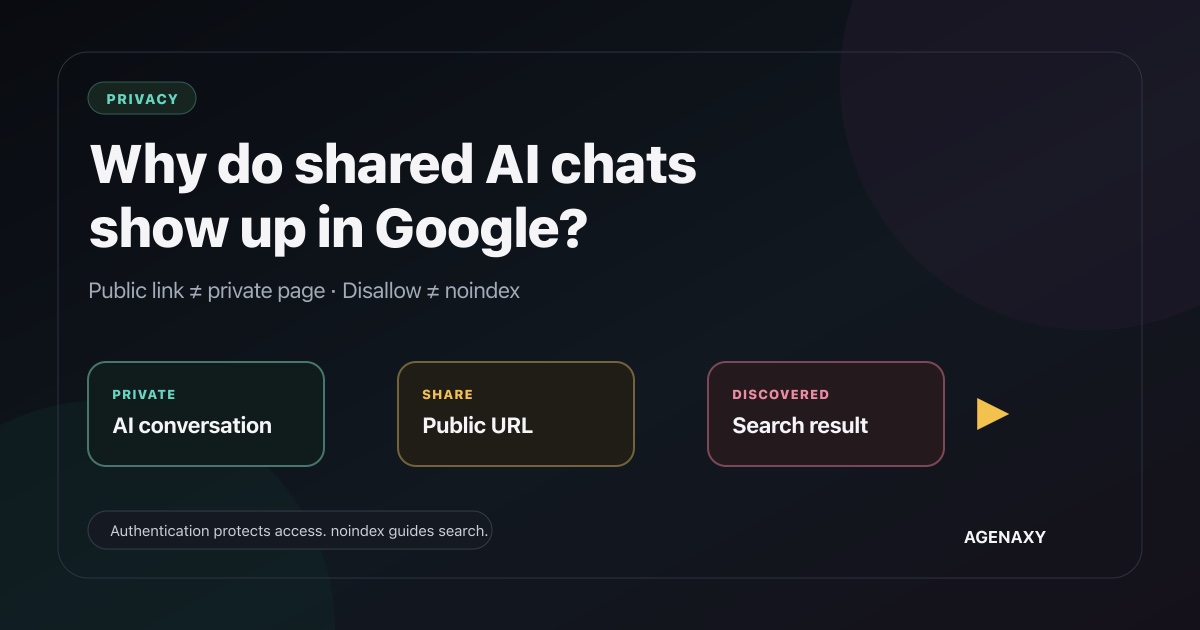
Quick answer: A shared AI chat can appear in Google when the share feature creates a public web page and
Google discovers its URL. A link that is hard to guess is not the same as a private page. robots.txt
controls crawling, not confidentiality, and a Disallow rule alone does not guarantee that a URL stays out
of search. If a conversation should remain private, require authenticated access or do not turn it into a
hosted share page.
If you have shared AI chats before, audit them now. Removing the original link reduces future exposure, but it cannot retrieve copies, imports, screenshots, or third-party archives that already exist.
Practical rule: Treat an AI share link as publication unless the viewer must authenticate and is authorized to see it.
Key facts
- Claude says chats are private by default. ChatGPT requires a user to generate a shared link before the linked conversation is viewable through that URL.
- “Anyone with the link” is public access, even when the URL is long and not listed in a directory.
- A public URL can become discoverable when it is linked from a crawlable page or otherwise exposed to a crawler; the discovery route for a particular shared chat may remain unknown.
Disallowasks a compliant crawler not to fetch a path.noindexasks a search engine not to index a page it can read.- Authentication controls who can read the content. It is the stronger boundary when content must not be public.
- Unsharing closes the vendor's original URL; it does not erase material another person has saved elsewhere.
1. Shared AI chats have reached search before
These incidents involved pages that users had shared or made public. They are not evidence that private, unshared conversations were directly indexed.
| Date | Product | What was reported | Important qualification | Source |
|---|---|---|---|---|
| September 2023 | Google Bard | Public Bard conversation links appeared in Google Search. Google said it was working to block them from indexing. | This was an early warning about public share pages, not private Bard chats. | Computerworld |
| July–August 2025 | ChatGPT | Searchable ChatGPT shared links were found after users used an optional discoverability setting. OpenAI removed the experiment. | Creating a shared link alone was not described as opting into search discovery. | TechCrunch and Search Engine Land |
| August 2025 | Grok | TechCrunch reported that large numbers of Grok share pages were searchable. | The reported count and content descriptions were not confirmed by xAI in that report. | TechCrunch |
| July 2026 | Claude | Public Claude shared chats and artifacts appeared in Google results, including pages that reporters said contained sensitive personal or work material. | The exact total and the route by which Google first discovered every URL remain unknown. | TechCrunch |
For the July 2026 Claude reports, Anthropic told TechCrunch that it did not provide Google with a directory or sitemap of shared chats, that share URLs were not guessable or discoverable unless users shared them, and that sharing made the pages publicly accessible. It also warned that third parties might archive public pages. That position matters: a vendor does not need to submit a URL to Google for a public URL to become discoverable elsewhere.
Search Engine Journal observed on July 27 that Claude's /share/ path was disallowed in robots.txt and that
a live share response carried an X-Robots-Tag: none header. The author could not verify which controls were
served when Google first found the pages. TechCrunch later found its test results had disappeared from Google,
but the exact remediation was not publicly established. Those observations should not be turned into a
confident claim about the original cause or fix.
2. Why this happens: Disallow is not noindex
Four separate questions determine the outcome:
- Did the product create a URL that works without authentication?
- Did Google or another crawler discover that URL?
- Was the crawler allowed to fetch the page?
- After fetching it, was the crawler told not to index it?
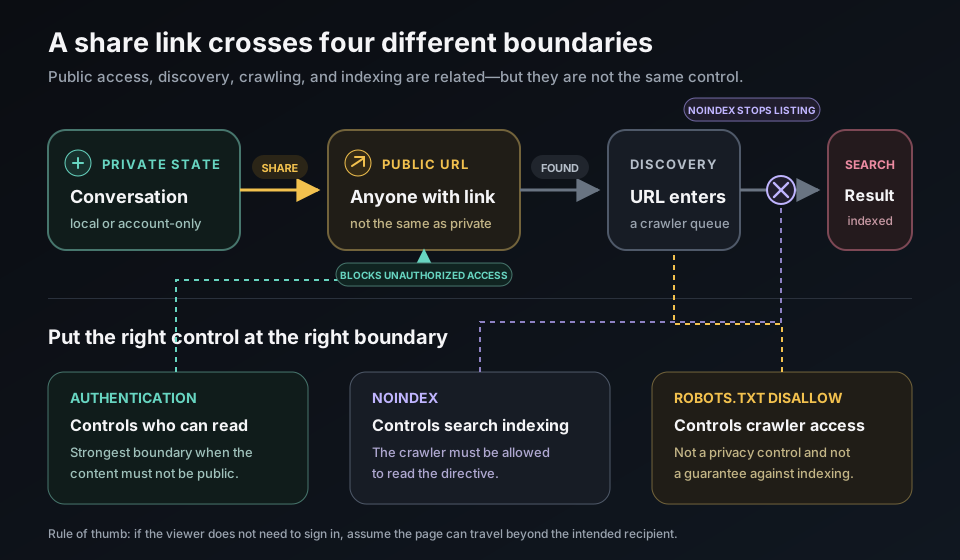
noindex is an indexing instruction.Scroll the diagram horizontally to inspect the decision path.What robots.txt actually does
A site can place Disallow: /share/ in robots.txt. Compliant crawlers should not fetch matching pages.
That can reduce crawling, but Google explicitly warns that a blocked URL can still appear in results when
other pages link to it. Because Google cannot crawl the blocked page, it cannot see a page-level noindex
instruction there.
What noindex does
A page can provide noindex in a robots meta tag or an X-Robots-Tag HTTP header. When Google crawls the
page and reads that directive, Google says it will drop the page from search results. none is shorthand for
noindex, nofollow.
This creates a common configuration trap:
| Control | What it controls | What it does not prove |
|---|---|---|
| Long, random-looking URL | Makes guessing less likely | That the page is private or undiscoverable |
robots.txt Disallow |
Whether compliant bots should crawl the path | That the URL cannot be indexed or opened by a person |
noindex |
Whether a crawler that reads the directive should index the page | That unauthorized people cannot open the page |
| Authentication and authorization | Whether a viewer may access the content | That authorized recipients will not copy it |
| Link revocation | Whether the original share URL still works | That prior recipients or archives lost their copies |
For confidential material, indexing controls are secondary. The primary protection is not publishing the content to an unauthenticated page in the first place.
3. What to do now
Audit Claude shared chats
Claude's current help documentation says chats are private by default. A shared chat creates a snapshot that anyone with the link can view; Team and Enterprise links are limited to people inside the organization. Attachments are not included in the snapshot, but conversation text and model output may reveal information from them.
In Claude:
- Open Settings.
- Open Privacy.
- Select Manage next to Shared chats.
- Review every link and choose Unshare where public access is no longer needed.
You can also open the shared conversation and use Share → Unshare. Confirm the current interface against Claude's help center because settings paths can change.
Audit ChatGPT shared links
OpenAI's current help documentation says anyone with a ChatGPT shared link can view the linked conversation. It does not offer granular permissions or expiration dates for ordinary shared links.
In ChatGPT:
- Open Settings.
- Open Data Controls.
- Open Shared links and select Manage.
- Delete links that are no longer necessary.
Deleting the original link prevents access through that URL. OpenAI notes that if a recipient imported the conversation into their own history, deleting your link does not delete that copy.
Handle a sensitive link as an incident, not a cleanup chore
If a link exposed customer data, health information, legal material, credentials, source code, or regulated records:
- Revoke or unshare the link and record the URL, time, product, account, and actions taken.
- Preserve enough evidence for your organization's incident process without spreading the content further.
- Rotate exposed credentials or tokens immediately.
- Notify the security, privacy, legal, or client-response owner required by your policy.
- Request search removal where appropriate, while remembering that removal from search does not remove every copy from the web.
This is practical technical guidance, not legal advice. Notification and preservation duties depend on the data, jurisdiction, contracts, and organization.
Use a five-question check before sharing again
- Does the recipient need the whole conversation, or only an approved artifact?
- Will the link open in a private browser without signing in?
- Does it contain names, prompts, file excerpts, system details, credentials, or client facts?
- Can the link expire or be limited to specific authenticated people?
- Who will own revocation, recipient copies, and the audit record?
If any answer is unclear, export a reviewed document through an approved channel instead of publishing the raw conversation.
| What you need | Safer default |
|---|---|
| Material intentionally meant for the public | Use a public share link only after reviewing the complete page |
| Collaboration among known colleagues | Use authenticated organization access with the narrowest audience available |
| A recipient needs the result, not the raw reasoning | Send a reviewed artifact through an approved channel |
| The working material does not need to be hosted | Keep the working surface local and publish only the approved output |
4. The larger issue is the trust surface
Search indexing is one visible outcome. The more useful question is: which systems, settings, vendors, and legal processes can affect an AI conversation over its lifetime?
Different events illustrate different trust surfaces and should not be conflated:
| Example | What it demonstrates | What it does not demonstrate |
|---|---|---|
| OpenAI's March 2023 Redis-library bug | OpenAI reported that some users could see titles from another active user's chat history; payment-related information may also have been visible to a subset of active Plus subscribers. | That public share links caused the incident. |
| OpenAI's 2025 Mixpanel incident | OpenAI reported that a compromised analytics provider exposed limited account and telemetry fields for some platform/API users and a limited number of ChatGPT users associated with help-center tickets or platform.openai.com. | OpenAI says prompts, responses, API keys, passwords, payment details, and chat content were not exposed. |
| Anthropic's 2025 consumer-terms update | Anthropic says consumer users who allow model improvement can have new or resumed chats retained for five years; otherwise the stated period is 30 days. | That the same terms govern commercial products or that all chats are retained for five years. |
| OpenAI's New York Times litigation disclosure | OpenAI says it complied with a court order concerning 20 million private consumer ChatGPT conversations after applying a process intended to remove or mask personal information and imposing access controls, while continuing to object to the demand. | That those conversations were published or made available to Google. |
| Public share-link indexing | A hosted page can move from “anyone with the link” to search discovery. | That private-by-default chats were indexed without a public page. |
The controls also differ: application isolation, third-party vendor governance, retention settings, legal holds, public-link access, indexing directives, and user revocation solve different problems. A privacy claim that covers only model training or only encryption leaves most of this lifecycle unanswered.
5. A different default: keep the working surface local
For work that does not need to become a web page, a local-primary workspace changes the default. The files, instructions, history, memory, and artifacts remain on the user's device, and running an agent does not by itself create a hosted public URL. Publishing, exporting, synchronizing, or choosing a cloud model remains a separate action with its own boundary.
Agenaxy is designed around that local-primary Space. Standard mode can use selected local or cloud models. Vault permits only explicitly authorized model Connections, provides only local Tools that do not send data out, and uses an OS/process sandbox to deny network access for Agent scripts and subprocesses. With a local model, model context stays on the device; an authorized remote model receives the task context sent to it. This design reduces the number of conversations that need share links. It does not prevent a user from deliberately exporting or publishing content elsewhere, and it is not a compliance certification.
The deeper distinctions are covered in what truly local-first AI means, the local-first AI agent workbench, and local AI vs cloud agents.
If one file-heavy workflow should remain a local working surface, describe its inputs, required artifact, and acceptable external paths in the Download Agenaxy form. Do not submit confidential content, customer records, credentials, or production data.
Key takeaways
Do not use a search setting to solve an access problem. Authenticate the people who need the raw conversation, send a reviewed artifact when they only need the result, and keep the working surface local when no hosted page is necessary. Revocation is damage limitation, not recall.
FAQ
If a shared chat is not in Google, is it private?
Not necessarily. An unindexed page can still be public to anyone who obtains its URL. Check whether the viewer must authenticate and whether access is limited to named people or an organization.
Should a sensitive shared chat use noindex or authentication?
Authentication and authorization. noindex is an instruction to search engines, not an access control. If
the content should never be public, do not rely on indexing controls alone.
Sources and Fact-Checking Notes
- Google Search Central: Block search indexing with
noindexand robots meta tag specifications define the crawl/index distinction used in this article. - Claude Help Center: Share and unshare chats and OpenAI Help Center: ChatGPT shared links FAQ provide the current privacy descriptions, audience rules, revocation paths, and copy limitations.
- The incident timeline is based on Computerworld's Bard report, TechCrunch on ChatGPT, Search Engine Land's follow-up, TechCrunch on Grok, TechCrunch on Claude, and Search Engine Journal's dated technical observations. Counts, content descriptions, and vendor responses remain attributed to those reports.
- The broader trust-surface examples come from OpenAI's March 20 ChatGPT outage report, Mixpanel incident notice, and New York Times litigation page, plus Anthropic's consumer-terms update.
- Sources and product help pages were checked on 2026-07-29. Interface paths and search results can change. This article distinguishes vendor documentation, attributed reporting, and Agenaxy's own decision framework; it is not legal advice.