What Is Silent Cloud Fallback—and Why Does It Matter?
Quick answer: Silent cloud fallback is an application behavior where a task expected to run locally is rerouted to a remote model or service without a clear, task-level choice. It can happen when the local model is unavailable, too small, or missing a feature. The problem is not that cloud processing exists; it is that the data path changes without the user knowingly authorizing that path.
A good local-first product can offer cloud models. It should make the connection explicit and fail visibly when the approved path cannot run.
A concrete example
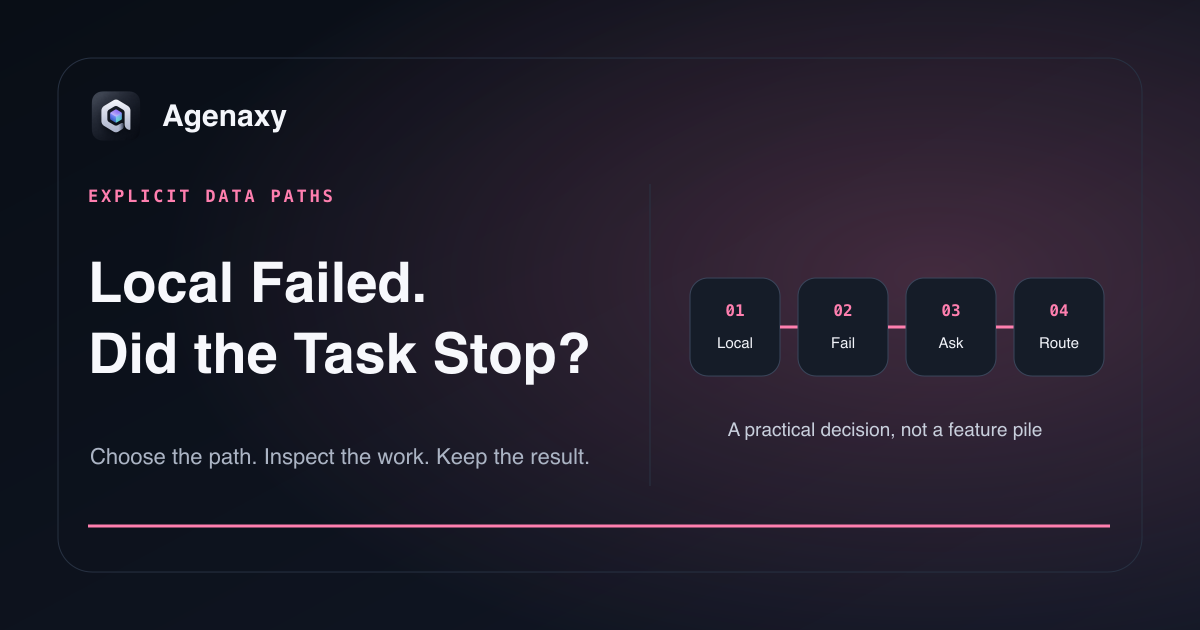
You select a local model and ask an app to summarize a confidential PDF. The local runtime cannot load the requested model. Three outcomes are possible:
- Visible failure: the app says the local model is unavailable and asks what to do.
- Explicit switch: the app shows a remote provider, explains that selected content will be sent, and waits for authorization.
- Silent fallback: the app sends the prompt or file excerpts to a configured cloud endpoint and returns an answer that looks normal.
Only the third is silent cloud fallback. A clearly labeled cloud option is not.
Why users may not notice
The interface can look identical whether inference happens on the Mac or a server. A response may even arrive faster after fallback. Common clues are indirect:
- the answer succeeds while the local runtime is stopped;
- the app works after local memory/load failure;
- a remote API usage record appears;
- network traffic occurs during the task;
- the activity log names a different model or provider;
- terms such as “smart routing,” “auto,” or “best available” are enabled without a clear per-task path.
None of these alone proves an unauthorized transfer. Inspect the product documentation and the recorded Connection for the actual task.
Cloud processing is not automatically bad
Remote models can provide more capability, lower local hardware requirements, and useful provider controls. Apple, for example, explicitly documents when more complex Apple Intelligence work uses Private Cloud Compute and how that remote system handles data. Microsoft documents that its “connected experiences” send relevant content to cloud services to perform features such as translation.
Those are visible architectural choices. The decision for a user is whether the stated remote path is acceptable for the particular data and task.
Test the exact path
Use public sample data:
- select the local model explicitly;
- record the app, model ID, and enabled tools;
- complete one normal task;
- stop the local model server or disconnect the network, depending on what you are testing;
- repeat the task;
- inspect the error, Activity, model/provider record, and API usage;
- confirm that the application did not substitute another path.
Do not use a packet capture or firewall rule as the only explanation. They can show a connection, while product/activity records help explain which feature made it.
Check every component, not only inference
An application may keep model inference local while using remote:
- embeddings or document indexing;
- optical character recognition;
- web search;
- speech transcription;
- telemetry or crash reporting;
- tool/API calls;
- model and runtime downloads.
Label these paths separately. “The model is local” is narrower than “the complete workflow is offline.”
What fail-closed means here
For this data-path decision, fail-closed means the task stops when the approved model Connection is unavailable. NIST defines fail secure as terminating in a way that prevents loss of the secure state. Applied here, the concrete outcome is simple: the user gets an error instead of the application sending work to an unapproved endpoint.
This does not require elaborate recovery machinery. Show which Connection failed, preserve the unsent work, and let the user choose another authorized path.
A product checklist
- Does the UI name the active model and provider?
- Is “automatic routing” explained and optional?
- Does a remote path require an explicit Connection?
- Does Activity record which model handled the task?
- When the local path fails, does the task stop visibly?
- Are embeddings, tools, search, and telemetry documented separately?
- Can you test without confidential data?
Where Agenaxy fits
Agenaxy keeps the model layer replaceable but does not treat models as interchangeable data paths. Standard uses the Connection selected for the task. In Vault, every model Connection must be explicitly authorized; there is no silent cloud fallback. An authorized remote model still receives the context sent to it.
Vault also keeps outbound-data tools unavailable and blocks network access for agent-run scripts while limiting tools and scripts to approved files and folders.
Read what truly local-first AI means for the broader architecture or local vs cloud agents for deployment tradeoffs.
Try an explicit model path
Describe a non-confidential task and whether it should use a local or authorized remote model in Download Agenaxy. Do not submit files, credentials, customer records, or production data through the form.
FAQ
Is using a cloud model always a fallback?
No. If you select and authorize the cloud model for the task, it is the intended path.
Can I detect cloud fallback from the browser or app?
Sometimes through Activity, model labels, provider usage, or network observation. The most useful design is for the product to record the active Connection explicitly.
Does airplane mode prove everything is local?
It can test whether one path completes offline. It does not describe what happens when the network returns or whether model downloads, embeddings, tools, or updates use remote services.
Sources and Fact-Checking Notes
- NIST — Fail Secure defines termination that prevents loss of secure state.
- Apple — Private Cloud Compute explicitly distinguishes on-device and cloud processing and documents the remote privacy architecture.
- Microsoft — Connected experiences documents cloud-backed features that send content to the service needed to perform the feature.
- Agenaxy product statements are checked against
agenaxy/apps/site/public/llms-full.txtand ADR-066.