ChatGPT Free vs OpenRouter + Agenaxy: Which One Should You Use?
On this page
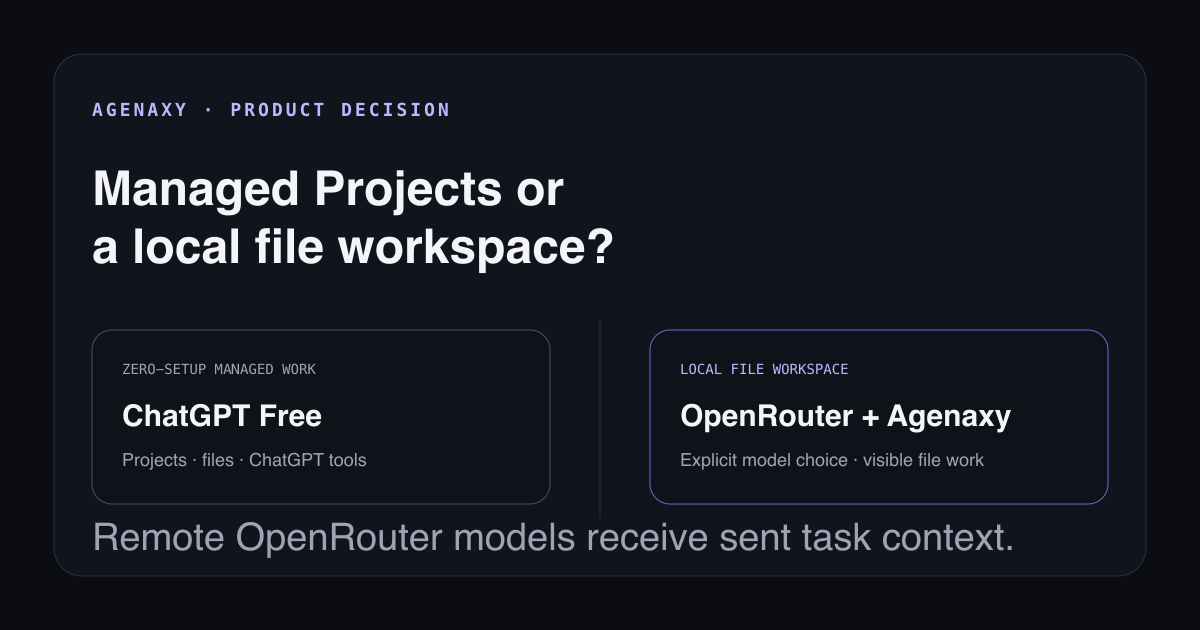
Quick answer: Use ChatGPT Free when you want useful AI with no API key, provider setup, or model-selection work. It supports everyday chat, files, web search, data analysis, images, and managed Projects, subject to current Free-tier limits. Use OpenRouter with Agenaxy when you want a local Mac Session workspace, a concrete model Connection you choose, visible file activity, and explicit model switching. A remote OpenRouter model still receives the context sent for the task; “local” describes the durable workspace, not the inference call.
ChatGPT Free is the better choice for many one-off tasks. Agenaxy starts to matter when the answer is no longer the main thing you need to keep—the files, revisions, and continuing work are.
Use ChatGPT Free when the task should be simple
Open ChatGPT, ask the question, attach a file if needed, and get an answer. That ordinary path is hard to beat when the work is:
- translating a paragraph;
- checking a fact with web search;
- summarizing a temporary document;
- drafting an email or short post;
- exploring an image;
- analyzing a small dataset once;
- trying a GPT without configuring an API service.
OpenAI's current Free Tier FAQ describes everyday text chat subject to abuse-prevention safeguards, plus web search, data analysis, file or image uploads, GPT discovery, image generation, and Library. Several tools have separate usage limits.
If the task ends when the answer appears, start with ChatGPT Free. Adding a provider account and another desktop application would create work without solving a real problem.
Do not underestimate ChatGPT Projects
ChatGPT Free is not limited to disposable chats. Projects are available across Free and paid plans. A Project can keep chats, uploaded reference files, project instructions, memory, and familiar ChatGPT tools together. The current Free limit is five files per project.
Choose a ChatGPT Project when you want managed continuity with almost no setup:
- related conversations in one place;
- reusable project instructions;
- a small reference set available to future chats;
- project memory and supported ChatGPT tools;
- sharing within the current plan's limits.
That is a real project surface. Its defining characteristic here is that ChatGPT manages the product, model access, files, memory, and collaboration experience for you.
Use OpenRouter + Agenaxy when the work surface matters
Agenaxy takes a different ordinary path. It is a local-first Mac workbench. You add an OpenRouter Connection, choose a concrete model, and work inside a local Chat Session workspace.
This path becomes relevant when:
- the same folder will be used for days or weeks;
- the agent must read or edit several ordinary workspace files;
- source inputs must remain read-only while result files stay editable;
- you want Workspace and Activity views for what happened;
- a free model may disappear and you want to switch explicitly to another model in the same Session;
- the work should remain usable even after the selected model changes.
Agenaxy does not silently substitute a different model, Connection, or credential. Switching is an explicit user action. OpenRouter may still choose or fail over among upstream providers serving the same concrete model, so OpenRouter's provider and data-policy settings remain part of the path.
One task, two ordinary paths
Consider the same request:
Review this week's vendor notes and prior brief.
Update vendor-brief.md with decisions, owners, open questions,
and the source filename for every material claim.
Do not change the source notes.
ChatGPT Free path
Create or open a Project, add the same source files within the plan limit, set project instructions, and ask ChatGPT to produce the complete Markdown brief with decisions, owners, open questions, and a source filename for every material claim. Review the result, then download it or save/copy it as vendor-brief.md. Keep using that Project when the managed ChatGPT context and tool set are the work surface you want.
OpenRouter + Agenaxy path
Open a local Session workspace, add the same source files, select an OpenRouter model Connection, and ask the agent to update vendor-brief.md with the identical required fields and source filenames. Inspect Activity and the resulting local file. If a different available model is a better fit later, switch models explicitly while keeping the same Session workspace.
Neither path wins by definition. The useful question is which ordinary surface matches where you want the work to live and how much setup you are willing to manage.
The real difference is not free versus paid
ChatGPT Free, OpenRouter's :free endpoints, and Agenaxy are separate product layers. Neither ChatGPT Free nor an OpenRouter endpoint establishes Agenaxy's own price or availability; check Agenaxy's current terms as a separate product decision. The products also have different account and execution models.
| What you need | Better starting point |
|---|---|
| One-off chat, search, translation, or draft | ChatGPT Free |
| No API key or provider decision | ChatGPT Free |
| Managed Projects, memory, sharing, and ChatGPT tools | ChatGPT Free |
| A local Mac Session workspace with editable files | OpenRouter + Agenaxy |
| Explicit choice among concrete remote or local model Connections | Agenaxy — OpenRouter for remote models, or a separate local Connection |
| Visible Workspace and Activity around file work | OpenRouter + Agenaxy |
| Zero-setup questions plus separate ongoing local file work | Use both; keep their accounts and work state separate |
| No task context sent to a remote model | Agenaxy with a suitable local model, not an OpenRouter endpoint |
| Predictable production capacity, central administration, or a service commitment | Neither option by itself |
OpenRouter requires its own account and API key. ChatGPT product access is separate from API access and billing; ChatGPT Free does not become an OpenRouter or OpenAI API allowance.
Using both can be sensible: keep disposable questions in ChatGPT Free and use Agenaxy for the folder workflow that needs a continuing local file surface and explicit model choice. Nothing automatically synchronizes their accounts, conversations, files, or work state.
If OpenRouter's free allowance is the attraction, read how the current 50 / 1,000-request limits work and check the current editorial free-model top pick.
Privacy is a data-path decision, not a product label
ChatGPT users can turn off Improve the model for everyone; OpenAI says new conversations will then remain in chat history but will not be used to train ChatGPT. Projects follow the plan's data controls and retention terms.
With OpenRouter, prompts pass through OpenRouter to an eligible upstream provider. At OpenRouter's own platform layer, full prompt and response logging is opt-in, while non-content request metadata is stored. Upstream logging, retention, and training policies can differ.
Apply each routing control to its actual requirement: use data_collection and provider allow/exclude filters for acceptable upstream paths, and enforce ZDR when zero retention is required. Agenaxy keeps the Session workspace local, but a remote model still receives the context sent for the task.
If the requirement is that no model context leave the Mac, choose a suitable local model Connection. “Local-first” describes who owns the durable work surface; it does not turn a remote request into local inference.
When should you choose neither option?
Free access is useful for personal work, learning, and evaluation. It is not a substitute for every operational requirement.
Evaluate paid or organizational options when you need predictable throughput, formal support, centralized user administration, contractual data terms, larger managed collaboration, or a production service commitment. The right answer may also be to keep a sensitive task entirely offline or not use a general-purpose model for it.
The smallest reason to try Agenaxy
Use the same local file workspace, explicitly change the model, and continue editing the same result file. That is the product difference this comparison is asking you to test.
Bring one copied, non-confidential folder task to Download Agenaxy. Do not submit source files, credentials, customer records, or production data through the website.
Sources and Fact-Checking Notes
- OpenAI — ChatGPT Free Tier FAQ documents current Free access, tools, and separate tool limits. Checked August 30, 2026.
- OpenAI — Projects in ChatGPT documents availability across plans, chats, files, instructions, memory, tools, sharing, current Free project limits, and plan data-control inheritance. Checked August 30, 2026.
- OpenAI — Data Controls FAQ documents the account-wide model-training control. Checked August 30, 2026.
- OpenAI — ChatGPT and API billing separation documents separate API service and billing. Checked August 30, 2026.
- OpenRouter — Limits documents current free-model account limits. Checked August 30, 2026.
- OpenRouter — Provider Logging documents upstream provider logging, retention, and training-policy variation. Checked August 30, 2026.
- OpenRouter — Data Collection distinguishes opt-in prompt/response logging from stored request metadata. Checked August 30, 2026.
- OpenRouter — Provider Routing and Zero Data Retention document provider filters,
data_collection, and ZDR enforcement. Checked August 30, 2026. - Agenaxy statements are checked against ADR-071, ADR-074, ADR-077, and the current project boundary.