OpenRouter Free Models: How the 1,000 Requests per Day Limit Actually Works
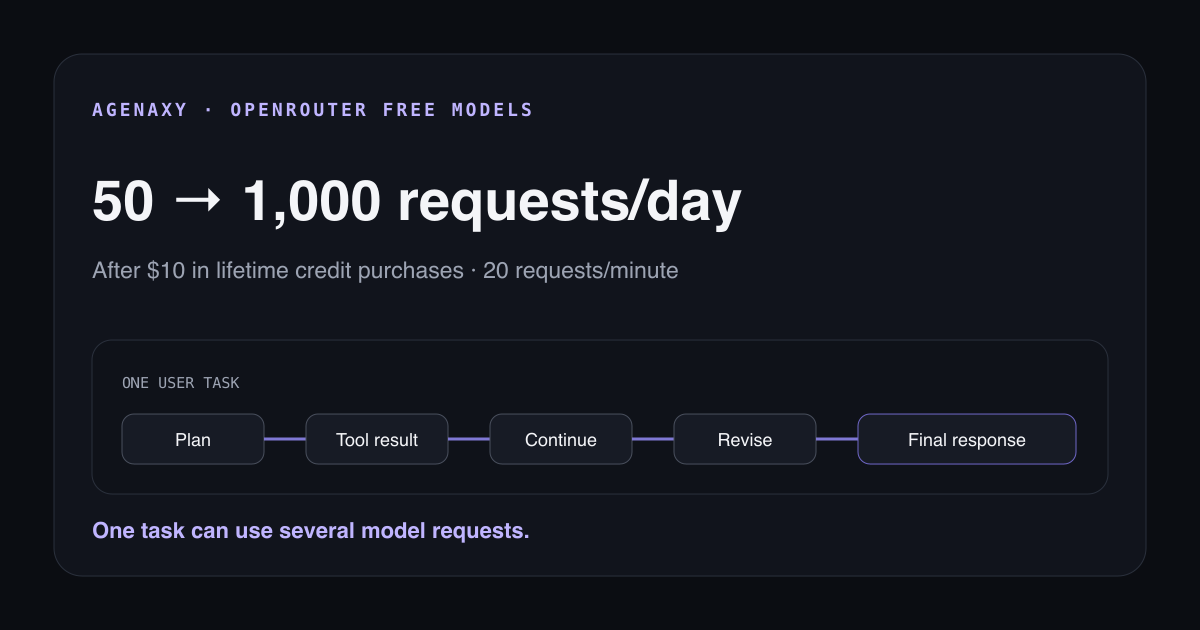
Quick answer: OpenRouter accounts with less than $10 in all-time credit purchases can make up to 50 free-model requests per day. Once all-time purchases reach at least $10, the account-level cap rises to 1,000 free-model requests per day. Both tiers remain limited to 20 requests per minute. The allowance is shared across free models, and one agent task can use several model requests.
That makes the offer useful for learning, evaluation, and irregular personal work. It does not make free endpoints unlimited, permanently available, private by default, or suitable for a workload that requires a service guarantee.
On this page
What does the $10 requirement actually mean?
OpenRouter's current limits use credits purchased all time, not a recurring subscription and not a $10 daily charge. Reaching the threshold changes the platform-level daily request cap for models whose IDs end in :free.
| Account state | Free-model requests per minute | Free-model requests per day |
|---|---|---|
| Less than $10 purchased all time | 20 | 50 |
| At least $10 purchased all time | 20 | 1,000 |
The 1,000 requests belong to the account's free-model allowance. They are not 1,000 requests for every free model. Creating more API keys does not multiply the account-level capacity.
Credits remain ordinary OpenRouter credit that can be used for paid inference. The important distinction is that the threshold looks at how much the account has purchased, while a separate credit balance and any per-key spending cap still govern what the account can spend.
Last verified: August 30, 2026. OpenRouter can change limits, model availability, and endpoint conditions, so check the current limits page before planning around the numbers.
What counts as one request?
One request is one model API call. It is not necessarily one question, one user action, or one completed agent task.
A simple chat normally uses one model request for one response. An agent may call the model again after reading a file, receiving a tool result, encountering a recoverable problem, or preparing a revised answer. A single task can therefore consume several requests from the daily allowance.
Illustrative task trace:
One user task
→ 1 planning/model call
→ 2 calls after tool results
→ 1 revision call
→ 1 final-response call

Approximate total: 5 model requests
This is an explanation of request accounting, not a fixed Agenaxy ratio. A short answer may use one call. A multi-step file task may use more or fewer than five, depending on its tools, model behavior, failures, and review path.
OpenRouter's current first-party guidance also says failed free-model requests caused by rate limits, provider outages, or timeouts still count against the daily allowance. A retry can consume another request before the task produces useful work.
At an illustrative five successful requests per task, a 50-request daily allowance would cover roughly ten such tasks and a 1,000-request allowance roughly two hundred only when no additional failed attempts or retries consume the quota. Do not use those numbers as a capacity promise: the task shape, endpoint, and upstream conditions still decide what completes.
Are the models really free?
For a listed :free endpoint, OpenRouter shows zero prompt and completion token prices. The account is not charged token fees for those free requests.
“Free” describes token price. It does not make every other property equal to the paid endpoint:
- the free endpoint may expose a smaller context window;
- the underlying provider may have less capacity at busy times;
- the free roster can add, remove, or replace models;
- supported inputs and tool features vary by model;
- provider logging, retention, and training policies still apply;
- an upstream provider can return its own rate-limit or capacity error before the account reaches its daily cap.
OpenRouter's openrouter/free route reduces one kind of selection work. It filters the free pool for capabilities required by the request—such as image input, tools, or structured output—and then selects a compatible model at random. That can be convenient for experimentation, but it does not give you a stable concrete model identity for every task.
If you want a specific default rather than a random compatible route, see the current OpenRouter free-model ranking.
What this does not mean
The current 1,000-request rule does not mean:
- 1,000 requests for each model;
- 1,000 completed agent tasks;
- unlimited calls per minute;
- guaranteed access to a particular free endpoint;
- the same context or capacity as a paid endpoint;
- automatic privacy or zero data retention;
- a production-grade service commitment.
OpenRouter documents provider-specific logging, training, and retention policies. A free price does not answer where an eligible provider processes data, whether it retains data, or whether an endpoint qualifies for zero data retention.
For sensitive work, apply the controls to the exact requirement. Use OpenRouter's data_collection control to exclude providers that may collect data for training where that control applies. Use ZDR enforcement when the requirement is zero retention. For other provider retention terms, manually allow or exclude providers: OpenRouter displays those policies but does not automatically turn every retention term into a routing rule.
OpenRouter's own platform layer is separate from the upstream provider layer. OpenRouter says full prompt and response logging is opt-in, while it still stores non-content request metadata such as token counts and latency. If neither the platform settings nor any eligible upstream path are acceptable, choose another model or a suitable local model rather than treating :free as a privacy label.
Who is the allowance useful for?
It is a practical fit when…
- you are learning the OpenRouter API or testing an agent loop;
- your usage is irregular and can tolerate temporary rate limits;
- you want to compare concrete models before buying inference;
- you are a student, independent worker, or small team with flexible timing;
- you are willing to check model and provider details when the free roster changes.
It is a poor fit when…
- the work requires a production SLA or predictable throughput;
- one unavailable endpoint would block a customer-facing process;
- you do not want to manage an API key or provider choice;
- your data policy requires a property the current free endpoint does not provide;
- you only need occasional disposable questions and prefer a zero-setup consumer app.
The daily cap is generous for many experiments. Operational fit still depends on what happens when the preferred endpoint is unavailable.
How do you use changing free models without rebuilding the work?
Free endpoints can be useful, but their availability can change. A strong model may appear, lose capacity, or leave the free pool. The durable part of the workflow should therefore be the work itself: its files, instructions, required output, and review checks.
Agenaxy treats OpenRouter as a named model Connection and keeps ordinary Chat files in a local Session workspace. You choose a concrete model rather than a cross-model router. If another available model becomes a better choice, you can explicitly switch the model for later provider calls in the same Session. Agenaxy does not silently replace the selected model, Connection, or credential.
That model-level choice does not freeze OpenRouter's physical upstream. OpenRouter may automatically fail over among eligible providers serving the same model, and provider data policies can differ. When you use a remote OpenRouter model, the chosen OpenRouter route and its selected upstream receive the context sent for the task. Keeping the workspace local does not turn that remote call into local inference.
This separation is the reason to use a workbench rather than make a free endpoint the owner of the project. The endpoint can change while the Session workspace and editable work files remain available.
Start with one current model
Use the current free-model page to choose one current model and note one backup you could switch to manually, then bring a non-confidential file task to Download Agenaxy. Do not submit files, credentials, customer records, or production data through the website.
Sources and Fact-Checking Notes
- OpenRouter — Limits defines credits purchased all time, the $10 threshold, 20 requests per minute, the 50 / 1,000 daily caps, and same-model upstream-provider failover after provider-side failures. Checked August 30, 2026.
- OpenRouter — Lowest-Cost LLM Inference explains zero token pricing, context differences, free-tier capacity, failed-attempt quota consumption, retry risk, and the same current limits. Checked August 30, 2026.
- OpenRouter — Free Models Router documents random selection after capability filtering and zero prompt/completion token price. Checked August 30, 2026.
- OpenRouter — Provider Logging documents provider-specific logging, retention, and training policies, including that other retention terms are displayed rather than automatically used as routing rules. Checked August 30, 2026.
- OpenRouter — Provider Routing documents
data_collection, provider allowlists, and request routing controls. Checked August 30, 2026. - OpenRouter — Zero Data Retention documents account-, guardrail-, model-group-, and request-level ZDR enforcement. Checked August 30, 2026.
- OpenRouter — Data Collection distinguishes opt-in prompt/response logging from stored request metadata. Checked August 30, 2026.
- The five-call task trace is illustrative request math, not a benchmark or recorded product run.
- Agenaxy statements are checked against ADR-071, ADR-074, and ADR-077.