Agenaxy vs ChatGPT Projects: Managed Project Context or Local File Work?
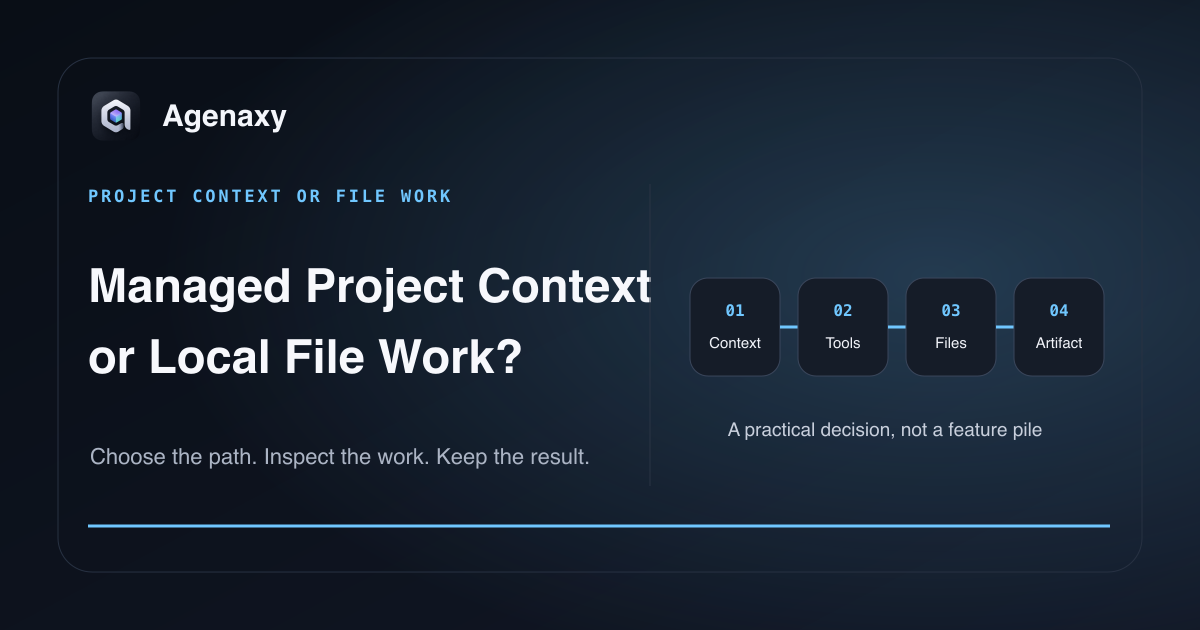
Quick answer: Choose ChatGPT Projects when you want OpenAI-managed project context: related chats, reference files, instructions, memory, sharing, and ChatGPT tools, with agent mode and deep research available on eligible paid plans. Choose Agenaxy when you want a local-first Mac workbench where an agent operates on selected files, exposes Activity, and creates editable Artifacts using a chosen model Connection.
This comparison uses official documentation checked August 6, 2026. Plan limits and tool availability can change, so verify the account you intend to use.
The short comparison
| Question | Agenaxy | ChatGPT Projects |
|---|---|---|
| Primary object | Local file assignment in a workbench | Managed project containing chats, files, and instructions |
| Model choice | Supported local or remote model Connections | Models and tools available in ChatGPT |
| Continuity | Files, Chat, Activity, and Artifacts in the workbench | Project chats, memory, files, and custom instructions |
| File work | Agent tools operate inside the current Chat file space | Files provide project context; ChatGPT tools can include agent mode and deep research on eligible plans |
| Typical result | Editable work Artifact | Conversation output and supported generated content |
| Core difference | Explicit local file boundary and model freedom | Turnkey managed context, sharing, and ChatGPT tool access |
OpenAI describes Projects as smart workspaces that keep chats, uploaded reference files, and custom instructions together. Projects include memory/context and familiar ChatGPT tools. Sharing is currently available across personal and organizational plan families, while collaborator, file, administration, and advanced-tool limits vary by plan.
Choose ChatGPT Projects for organized continuity
Projects fit when your recurring need is:
- keep related conversations together;
- reuse project instructions;
- upload reference material for future chats;
- continue work across devices;
- use ChatGPT's available tools—including agent mode or deep research when the plan provides them—without operating a separate model runtime.
For a writing, research, or planning effort centered on conversation, this is a low-friction path. The provider manages the model service and product experience.
Check the exact apps, data controls, project memory mode, advanced tools, and plan terms used in your account. A managed Project can be highly capable; its key difference here is the provider-managed context and execution path, not an absence of agent features.
Choose Agenaxy for a local file assignment
Agenaxy fits when the unit of work is more concrete:
Use the selected proposal files.
Create comparison.md with requirements, differences,
unanswered questions, and source anchors.
Leave the source files unchanged.
The workbench keeps the selected sources, chosen model Connection, agent Activity, and new Artifact in one file-oriented surface. The model can be local or remote depending on the Connection and mode.
Choose this path when model replaceability, local work context, and an inspectable file-to-artifact run matter more than seamless ChatGPT account continuity.
Project memory is not the same as a file boundary
Memory answers “what can this product carry into later chats?” A file boundary answers “what can this agent process or change during this assignment?” These are different controls.
Likewise, uploading a file does not by itself answer:
- where the model processes its contents;
- which tools can access it;
- whether a script can use the network;
- where generated files and session history are stored;
- what happens when the selected path fails.
Compare the exact configuration, not the comfort of the word “project.”
Run the same public-folder test
Use copied, non-sensitive material:
Create decision-brief.md from these five files.
Include a source inventory, three findings, contradictory evidence,
open questions, and the filename supporting each finding.
Do not edit the source files.
Compare:
- time to set up the project/workspace;
- whether all five sources are represented;
- quality of source anchors;
- ability to create and retain the requested artifact;
- model and tool choices available;
- visibility into file operations;
- where the relevant data is processed and stored;
- correction effort.
The better product is the one whose ordinary path matches your work. Do not ask a managed project to provide a local file boundary it does not claim, or ask a desktop workbench to replace every cloud collaboration feature.
Where Agenaxy fits
Agenaxy is local-first, not local-only. Standard can use a selected local or remote model Connection. In Vault, each specific Connection must be explicitly authorized, outbound-data tools are unavailable, and agent-run scripts are blocked from network access. An authorized remote model still receives the context sent to it.
For a broader chat-versus-work comparison, read chat with documents vs let an AI agent work on documents.
Try the file-to-artifact path
Describe a non-confidential folder assignment in Download Agenaxy. Do not submit files, credentials, or production data through the form.
FAQ
Are ChatGPT Projects only folders for chats?
No. OpenAI documents reference files, custom instructions, memory/context, sharing, and a broad tool set in addition to chat organization.
Can Agenaxy use a cloud model?
The product architecture supports selected local or remote model Connections. A remote model receives the context sent to it.
Which is more private?
That cannot be decided from the names. Compare model provider, execution, storage, project memory, apps/tools, file scope, and network paths for your exact setup.
Sources and Fact-Checking Notes
- OpenAI — Projects in ChatGPT documents project chats, files, instructions, memory/context, tools, sharing, and current availability. Facts checked August 6, 2026.
- OpenAI — File storage and Library in ChatGPT documents current file-storage behavior; verify plan and regional availability for the account you will use.
- Agenaxy statements are checked against current
llms-full.txtand ADR-066.