Pi vs DeepSeek Harness vs Agenaxy: Coding Harness, Agent Runtime, or Workspace?
On this page
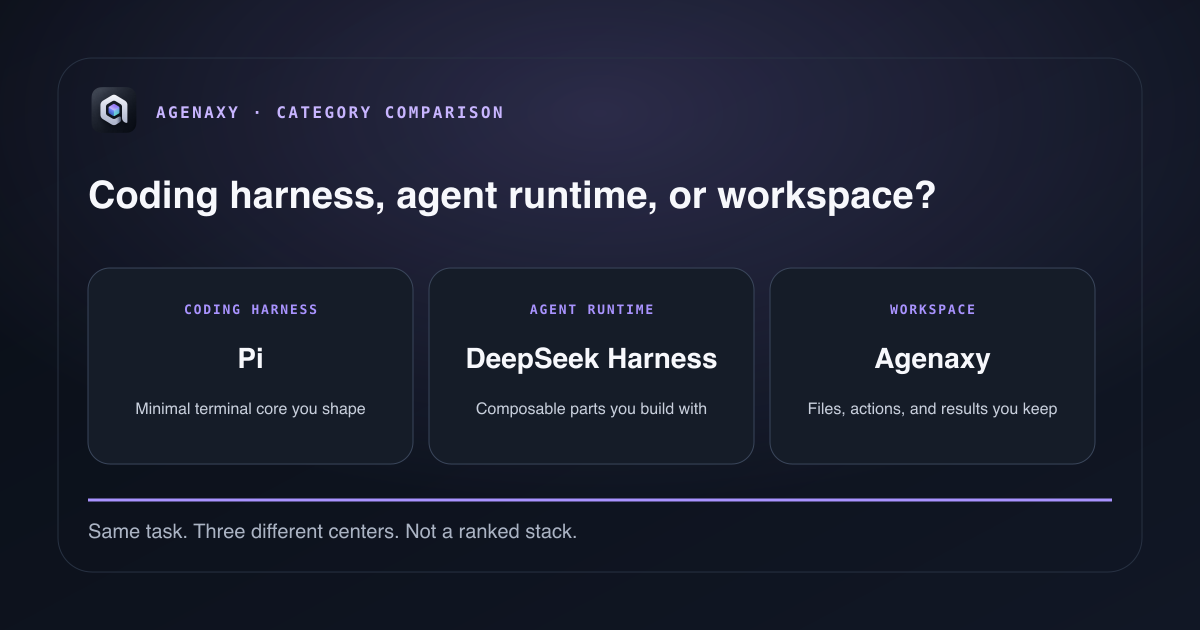
Pi, DeepSeek Harness, and Agenaxy all sit above the model layer, but they are not competing to be the same product. Pi is a minimal terminal coding harness. DeepSeek Harness is a composable agent runtime. Agenaxy is a local-first desktop workbench where people keep files, instructions, AI actions, and results together.
The useful question is not which one has the longest feature list. It is which object you want to own: a coding-agent setup, an agent runtime, or the workspace where the finished work lives.
Start with the question you are trying to answer
| If your primary question is… | Start with |
|---|---|
| How do I shape a minimal coding-agent workflow in the terminal? | Pi |
| How do I compose or build an agent harness from replaceable parts? | DeepSeek Harness |
| Where should my files, instructions, AI-assisted work, and results persist? | Agenaxy |
This is a category comparison, not a ranking. A developer who wants to construct the harness should not be persuaded to choose a finished workbench instead. A knowledge worker who wants to complete a recurring file task should not have to become a harness designer first.
Pi optimizes for a small core you can shape
Pi is ready to use as a terminal coding agent with read, write, edit, and bash tools, plus access to multiple model providers. Extensions, skills, and prompt templates are optional ways to adapt that working agent. Pi deliberately leaves features such as subagents and plan mode out of the default core. Pi coding-agent package
That restraint is the product idea. You can begin with its defaults, then decide how much structure to add. If you enjoy working in a terminal and want close control over coding-agent behavior, its minimalism is an advantage.
The tradeoff is equally direct: deeper tailoring remains your responsibility. Pi is the strongest fit when shaping the agent is something you intend to do, not an obstacle you want another product to remove.
DeepSeek Harness optimizes for composability
DeepSeek Harness can also begin as a working agent rather than an empty construction kit. Its Standard mode includes a full coding-agent toolset. Its “everything is a plugin” architecture then lets developers swap or recompose models, tools, skills, sessions, sandboxes, storage, loops, scheduling, and the UI through configuration. DeepSeek Harness
It also records what the model sees in an append-only session log and offers Standard, Code, Minimal, and Creator runtime modes. Those modes range from a full coding-agent toolset to a two-tool benchmarking environment and a setup for authoring custom presets.
This makes DeepSeek Harness a reasonable starting point when your goal is to build an agent runtime, plugin ecosystem, or agent product. It is still marked as a developer preview, and DeepSeek warns that its core plugins and APIs will continue to evolve. The repository separately warns of compatibility-breaking changes. DeepSeek Harness repository
Agenaxy optimizes for continuity of work
Agenaxy starts from a different object: the workbench. Its job is to keep attached files, task instructions, editable results, Activity, permissions, approvals, and data boundaries attached to the chat workspace rather than to a particular model or provider. Agenaxy
The model is replaceable infrastructure in that arrangement. You might use a cloud model for one task, a local model for another, and a different provider next month. The files and results remain in the same user-owned workspace.
That is valuable when your main problem is not “How should I implement an agent loop?” but “How do I keep this body of work moving without rebuilding it every time the model changes?” Agenaxy is intended for people doing document, data, and recurring workflow tasks who want the execution to remain visible and the work to remain theirs.
The comparison in one table
| Decision axis | Pi | DeepSeek Harness | Agenaxy |
|---|---|---|---|
| Primary audience | Developers shaping a coding agent | Developers building agent harnesses or products | Knowledge workers and AI power users doing file-based work |
| Primary object | Coding-agent session and setup | Composable agent runtime | Persistent local-first workbench |
| Design emphasis | Minimal and hackable | Plugin-based and recomposable | Continuity of files, actions, and results |
| Main interface | Terminal | Runtime with a Web UI | Desktop workbench |
| What you can customize | Optional extensions, skills, prompts, and workflow | Optional plugins, modes, and runtime composition | The task, model choice, permissions, and deliverable |
| Change that should not destroy the core value | Replacing a provider | Replacing a runtime capability | Replacing a model or provider |
One task, three different centers
Imagine an illustrative recurring task: update vendor-brief.md from a folder of notes and a CSV, preserve source references, and leave unresolved questions visible for a human decision.
With Pi, you can use the default terminal agent in the project directory to read the same files and edit vendor-brief.md. Add extensions, skills, or prompt templates only if the recurring task needs more structure.
With DeepSeek Harness, you can use Standard mode's full coding-agent toolset to run the same task. Plugin composition becomes the focus when you want to turn that workflow into a specialized runtime or agent product.
With Agenaxy, you attach the source files to one chat and begin with the deliverable. The main questions are which model should take this pass, what it may change, what needs approval, what Activity shows, and what remains for the person to decide.
The success criterion is the same in every case: an updated, source-linked brief with unresolved items intact. What changes is the layer you are choosing to construct or inhabit.
Can these layers be combined?
Yes, at the category level. A workspace can be powered by a harness, and a harness can call different models or providers:
User's work
    ↓
Workspace or workbench
    ↓
Harness or agent runtime
    ↓
Model and provider
This diagram does not claim a current integration among the three products. It shows why “Which one wins?” is the wrong framing. Pi and DeepSeek Harness concentrate on how agent behavior is assembled. Agenaxy's bet is that the durable user-facing layer should be the workspace, not a particular harness or model.
Which one should you choose?
Choose Pi if you prefer terminal work, want a deliberately small coding-agent core, and expect to customize the harness yourself.
Choose DeepSeek Harness if you are developing an agent runtime or product and need models, tools, sessions, storage, loops, sandboxes, scheduling, and UI to be composable parts. Its developer-preview status should be part of that decision.
Choose Agenaxy if your priority is a continuing body of file-based work and you want to switch models without turning each switch into a workspace migration.
You may need none of them. A plain chat interface is enough for occasional questions, and a direct model API is enough when your application already owns the files, state, tools, and controls.
If the workbench category fits, attach one PDF and one CSV to a new chat. Ask Agenaxy to save an editable decision memo, inspect Activity, and resolve one open question yourself.
Sources and fact-checking notes
External product facts were checked on September 4, 2026. Pi and DeepSeek Harness are developer-facing projects that can change quickly; verify their current documentation before choosing an architecture.