How to Delegate Work to an AI Agent Without Losing Control
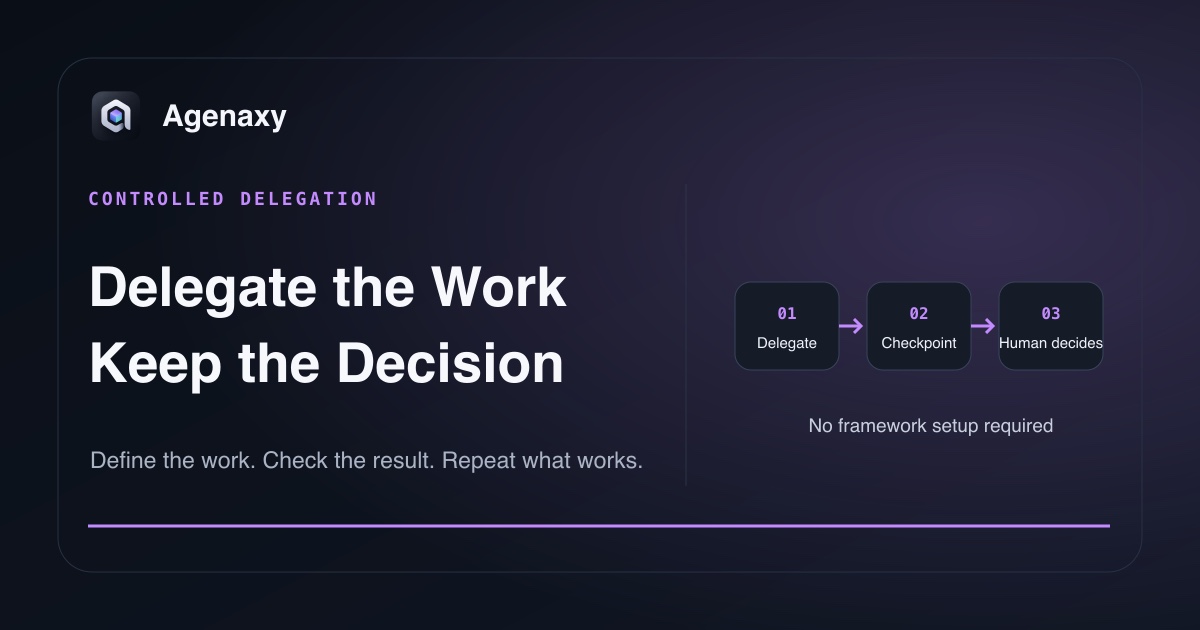
Quick answer: Delegate a bounded outcome, not unlimited responsibility. Name the sources, tools, changes, checkpoints, stop rules, and evidence the agent must provide. Keep irreversible actions, high-consequence decisions, and final acceptance with a person.
Control is not the same as watching every keystroke. It means deciding the boundary of the assignment and having enough evidence to accept, revise, or reject the result.
Decide what you delegate—and what you retain
| Delegate to the agent | Retain as the human owner |
|---|---|
| Inspect selected sources | Decide which sources are in scope |
| Choose steps among allowed tools | Decide which tools and connections are allowed |
| Draft, extract, compare, or calculate | Define what counts as correct |
| Flag ambiguity and exceptions | Resolve consequential ambiguity |
| Create a reviewable artifact | Accept, edit, reject, send, or publish |
| Record what happened | Decide whether the workflow runs again |
This division is task-specific. A person may delegate more after repeated, reviewed runs, but “the last run looked good” is not a reason to remove a decision gate automatically.
Write an eight-field delegation contract
1. Outcome
Name the deliverable, not a vague mission.
Weak: “Handle vendor renewals.”
Better: “Create renewal-brief.md listing renewal date, notice period, current terms, price changes, source section, and questions for the owner.”
2. Sources
List the selected folders, files, or records. State what must not enter the task. A working folder is an organizational boundary; check whether the product and operating system technically enforce the access you intend.
3. Allowed tools
Name the tools needed to produce the artifact. Do not enable email, browser, shell, or write access merely because the product offers them.
4. Change authority
State what may be created or changed. For an early run, prefer a new artifact and unchanged sources.
5. Checkpoints
In the task contract, a checkpoint tells the agent to pause. Useful checkpoints include:
- source conflict;
- missing required file;
- calculation mismatch;
- request for a new tool or connection;
- action outside the workspace;
- uncertainty that changes the recommended decision.
6. Stop rules
A checkpoint asks for a decision. In the task contract, a stop rule tells the agent to end or refuse the next step. Whether either rule is technically enforced depends on the product and permission boundary. Examples:
- do not continue if a source cannot be read;
- do not use an unapproved remote model;
- do not replace missing values with guesses;
- do not send, renew, cancel, approve, or delete;
- stop if the requested output would expose confidential content.
7. Required evidence
Ask for the evidence needed to review the work:
- source filename and section;
- calculation inputs;
- files read and skipped;
- tool or script record;
- assumptions and unresolved questions;
- exact output location.
8. Handback
Define what the agent returns and what the human decides next. A good handback includes the artifact, exceptions, blocked steps, and a short review checklist—not just “Done.”
Copy this delegation template
Outcome:
Create renewal-brief.md from the selected agreements.

Sources:
Use only files in Vendor-Renewals-Copy.

Allowed tools:
Read documents and create one Markdown artifact.

Change authority:
Do not edit, rename, move, or delete source files.

Checkpoints:
Ask when dates conflict or a referenced addendum is missing.

Stop rules:
Do not contact a vendor, renew, cancel, approve, or send anything.

Required evidence:
For every term, include source filename and section. List unreadable files.

Handback:
Return the brief, unresolved questions, and three checks for the owner.
Instructions and enforcement are different
“Do not access other files” is an instruction. Whether the agent can access other files depends on product design, operating-system permission, and enabled tools.
Use both layers:
- Task contract: tells the agent what the assignment permits.
- Technical boundary: limits what the app, model connections, tools, and scripts can actually do.
Instructions help the model behave. They are not a substitute for a permission boundary when the failure outcome matters.
Put approval where the outcome changes
Do not add an approval pop-up to every harmless read. Put human decisions before actions with a different consequence:
- a draft becomes a sent message;
- a proposed edit is applied to an existing or source file;
- an analysis becomes an approved decision;
- a local task sends context to a new service;
- a suggested fix runs against production.
This keeps review focused. A gate that appears constantly for low-consequence steps becomes noise; a missing gate before an irreversible action removes meaningful control.
Review the handback
Ask four questions:
- Did the agent stay inside the named sources and allowed tools?
- Does the artifact meet the output contract?
- Can important claims be followed to evidence?
- Are exceptions and blocked steps visible?
Then decide: accept, revise, reject, or rerun. The agent should not make that acceptance decision on its own.
NIST's AI Risk Management Framework emphasizes defined scope, human oversight, documentation, and risk response. A delegation contract turns those broad ideas into a work-level record.
Where model location fits
A cloud model receives the task context sent to it. A local model keeps inference on the machine, while tools and services can create separate data paths. Record the model connection as part of the delegation contract.
Where Agenaxy fits
Agenaxy is a local-first AI agent workbench for controlled file-based delegation. You select sources, inspect Activity, and receive editable Artifacts while originals remain untouched.
Standard can use a selected local or cloud model. In Vault, each model Connection must be explicitly authorized. An authorized remote server still receives the context sent to it, while outbound-data tools remain unavailable and agent-run scripts are blocked from network access.
Next, review human-in-the-loop agent decisions or the broader agent reliability control stack.
Try a bounded handoff
Describe one non-confidential delegation contract in Download Agenaxy. Do not submit files, credentials, customer records, or production data through the form.
FAQ
Is delegation the same as full autonomy?
No. Delegation assigns work within defined authority. Full autonomy implies much broader independent action, which is not required for most useful file workflows.
Should an AI agent ask before every step?
No. Use checkpoints where new authority or a different consequence appears. Routine steps inside the agreed boundary can proceed and remain visible in the run record.
Can instructions prevent an agent from accessing a file?
Instructions can direct behavior, but technical prevention depends on the product, operating-system permissions, and tools. Use enforcement when access must be blocked.
Who is responsible for the final result?
The human or organization using the result remains responsible for reviewing and deciding how it is used. An agent-generated artifact is not self-approving.
Sources and Fact-Checking Notes
- Anthropic — Building effective agents discusses simple agent designs, tool interfaces, evaluation, and human feedback.
- NIST AI RMF Core includes defined scope, human oversight, documentation, and risk responses among its outcomes.
- Agenaxy product statements are checked against current Standard and Vault canon.