Agenaxy vs n8n: File-Based Agent Work or App Automation?
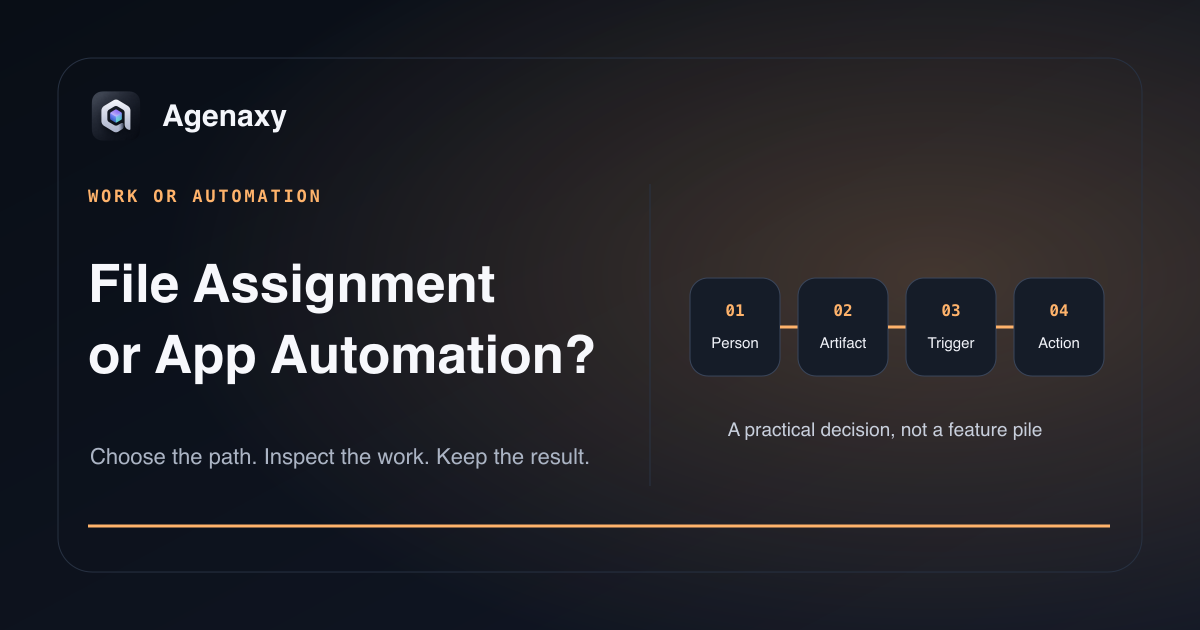
Quick answer: Choose Agenaxy when a person starts with selected files and wants a reviewable artifact from a local-first agent workbench. Choose n8n when an event, schedule, or application starts a flow that moves and transforms data across APIs. Combine them only when an approved artifact genuinely needs a downstream automation.
This comparison uses official product documentation checked August 6, 2026. n8n features, hosting options, nodes, and licensing can change.
The short comparison
| Question | Agenaxy | n8n |
|---|---|---|
| Normal starting point | A user opens a file assignment | A trigger, schedule, webhook, or manual workflow run |
| Primary object | Workspace, Chat, sources, Activity, Artifact | Workflow made from connected nodes |
| Main strength | Local-first knowledge work on selected files | Connecting apps/APIs and manipulating data |
| Model role | Replaceable model Connection inside the workbench | AI can be incorporated into an automation workflow |
| Setup burden | Configure the app, model path, and task | Configure hosting/account, credentials, nodes, and mappings |
| Typical output | A reviewed document, table, or file | Data or actions passed through connected systems |
n8n's official documentation describes it as a fair-code workflow automation tool that combines AI capabilities with business-process automation and connects applications through APIs. It offers cloud and self-hosted paths. Those facts make it a flexible automation system; they do not make it the same work surface as a desktop agent.
Choose Agenaxy for a folder assignment
Agenaxy fits work such as:
- compare a folder of agreements;
- turn interview notes into a decision brief;
- analyze a copied spreadsheet export;
- create a source-linked report;
- repeat a file-to-artifact task with a different model.
The human defines the assignment and reviews the Artifact. The source files, activity, and result remain visible parts of the same work context.
Choose it when the difficult part is interpreting material and producing something a person can inspect—not moving records between systems.
Choose n8n for event-driven app work
n8n fits work such as:
- when a form is submitted, validate and route the record;
- on a schedule, collect data from several APIs;
- update one system after another system changes;
- call an AI step inside a larger deterministic flow;
- maintain a shared automation that runs without a person opening a folder.
The value comes from explicit integrations and repeatable routing. Someone must own credentials, node configuration, data mappings, errors, hosting choices, and changes in connected services.
The same word “workflow” hides two jobs
In a workbench, a workflow can mean a reusable assignment:
New source folder → apply saved work order → review Artifact
In an automation platform, a workflow usually means an executable graph:
Trigger → fetch records → branch → transform → update app → notify
Both are valid. The first preserves a human-centered work context. The second operationalizes system behavior.
When to combine them
Use a clear approval boundary:
- Agenaxy creates
approved-customer-updates.csvfrom selected source files. - A person reviews and approves the rows.
- n8n reads the approved export and updates permitted applications.
Do not build this handoff before it is needed. If the result will simply be emailed once by a person, a permanent integration may add more ownership than value.
Test the choice with one task
Ask:
- What starts the work: a person, file arrival, schedule, or app event?
- What is the primary output: a reviewable artifact or a system action?
- How many external applications must be connected?
- Who owns failures and credential changes?
- Must the agent work inside a selected local file boundary?
If the answers are “person, artifact, few external systems, and selected files,” begin with a workbench. If they are “event, cross-app action, many integrations, and an automation owner,” begin with n8n.
For a category-level explanation, see AI agent workbench vs workflow automation platform.
Where Agenaxy differs
Agenaxy is local-first and model-flexible. Standard and Vault both keep Agent file access within the current Chat file space. Vault additionally requires explicit authorization for every model Connection, omits outbound-data tools, and blocks agent-run scripts from network access.
That boundary intentionally does not replicate n8n's broad integration role.
Try the file-work path
Describe one non-confidential folder assignment and desired artifact in Download Agenaxy. Do not submit files, credentials, or production data through the form.
FAQ
Can n8n use AI agents?
n8n documents AI functionality and tools inside its automation platform. Check the current nodes, hosting mode, and model/data path for the exact flow you plan to build.
Can Agenaxy replace n8n integrations?
Not as a general claim. Agenaxy's core job is file-based agent work; n8n's core job is connecting and automating applications and APIs.
Which is more private?
There is no answer at the product-name level. Compare deployment, model endpoint, credentials, connected services, storage, files, tools, and network paths for the exact configuration.
Sources and Fact-Checking Notes
- n8n documentation describes n8n as a fair-code workflow automation tool that connects apps and APIs, supports AI functionality, and offers cloud and self-hosted options. Facts checked August 6, 2026.
- Agenaxy statements are checked against current
llms-full.txtand ADR-066. - This is a documentation-based comparison; no hands-on benchmark or performance result is claimed.